

By Caylah Coffeen
Rating: 4/5 stars
The Lions of Al-Rassan is a richly researched historical fantasy novel about a fading Golden Age and the rivalry and love between men and women across borders, but the distant writing style leaves readers aching to be invited more closely into these cherished characters’ heart-wrenching conclusion.
Snapshot
The empire of Al-Rassan is crumbling. Jaddite raiders prey at their borders, led by the famous Captain Rodrigo Belmonte. The rulers of Al-Rassan turn on one another, compelling the infamous warrior poet Ammar to defy them. Jehane, a Kindath physician and daughter to the most famous doctor in the world, encounters and impresses both men as she seeks vengeance for her father. When both Rodrigo and Ammar run afoul of politics, they find themselves exiled to the same city, where Jehane helps binds their new mercenary band together. This is a story about the love and respect that can grow between people of warring cultures, but to a heartbreaking end.
Characters: 5/5
I read this story for Rodrigo Belmonte and Ammar ibn Khairan, two famous warriors from opposing countries. They form an understated friendship, deep and loyal, one that affects them for the rest of their lives. Ammar is quick to laugh, pretends to be a bit of a fop, is a master of disguise, blows where the winds take him – usually alone – and yet has an abiding, poetic love for his country and all things beautiful in the world. Rodrigo is a bit more stoic, collects talent around him, has twin sons and a wife whom he loves, and refuses to turn a blind eye to injustice. They are the best two warriors and strategists of their time, which means fate has pitted their swords against one another, though their hearts would rather stand together. It is achingly pleasurable to read.
Jehane intrigued me more as a character when she wasn’t with these men, honestly. When she is, she almost starts sounding like a YA character, snapping at them and throwing up a facade of indignant offense. But in her own thoughts she is self-aware, principled, deeply loyal, and a resolute professional. It was an interesting choice to make her a sort of bonding point for these two men. They both care for her, which enabled them to grow closer despite the growing war between their peoples. However, I was left feeling like she could have been removed from the plot, and Rodrigo and Ammar still would have had an unforgettable bond.
There are an overwhelming number of side characters in this book. While this slowed down the pacing and took the focus off the dynamic of the three main characters, perhaps damaging the ultimate emotional impact of the story, all of the side characters are fascinating and compel us to become invested in them. From the unique romance between Rodrigo’s King and Queen, and the shenanigans of his sons to the enduring friendship of an Asharite King and his advisor and the vulnerable spiritual musings of the leader of a fundamentalist warrior sect, we are treated to great intellect and heart from every quarter. Some of these chapters felt so well composed they could have been short stories of their own without losing their emotional impact.
I was particularly impressed by the author’s depiction of female characters. I find women, as written by modern authors, rather insufferable. Too often they seem like a cut-and-paste copy of the same self-consumed, cocksure, cheaply “witty” teenager. Not so of Guy Gavriel Kay’s female characters. We see a refreshing variety – a weary yet stoic wife caring for her disabled husband, a pious wife distraught by the lust she feels for her unbelieving husband, a ferocious mother and wife who doesn’t hesitate to kill her enemies and then punish her husband quite amusingly for causing the problem in the first place, and a vulnerable concubine grieving the loss of her partner even as she plots to overthrow his replacement. It shouldn’t feel like a treat to see a variety of personalities, careers, ages, and beliefs in female characters. This should be the norm. Until it is, I will cherish these characters all the more.
The kingdom of Al-Rassan is itself a character in this book. Or rather “a golden-age kingdom in its death throes.” We don’t necessarily love Al-Rassan itself, but we feel an incredible amount of melancholy and anguish for a fading empire that was once beautiful. This concept is so alive in our minds that at the end of the story we lament as much for her fall as we do for the human characters who are lost.
“Come, brother; Rodrigo Belmonte of Valledo had said today as five hard men with swords had walked forward to encircle the two of them. Shall we show them how this is done?
They had shown them. In no time at all, really, they were down, it was over. A dance.”
– Guy Gavriel Kay, The Lions of Al-Rassan
Story: 4/5
This plot jumps all over the place. Nearly halfway through the book, and I still had no real idea of where it was going. People wander from one city to another with a goal in mind that they just as quickly dismiss. There’s chaos in the world, and the reader knows a war is coming, but because this is built up so strongly in our minds, we think the plot will center around this war. Instead, we are treated to a series of much smaller, at times seemingly random, conflicts as they pop up for the characters. During the center of the book, some of our POV characters are sitting in a city doing very little, while we hop around to the POV of strangers who are actually pulling the strings of power. When I wanted to see Rodrigo and Ammar bonding, we were watching a fanatic chop peoples hands off.
I enjoyed looking at the fall of an empire from a smaller, character-driven perspective. The real plot was about cross-cultural interactions, lost relationships and dreams, surprising encounters and how they can shape our lives more surely than the ones we expected. However, I think the author needed to better set up reader expectations from the start. I think we needed fewer point of view characters in the first Act to focus more tightly on Jehane, Rodrigo, and Ammar. This would have clearly demonstrated that the story would follow them, not necessarily center around the war. Later insertions of POVs around the world could have pieced together larger events without risking leaving the reader feeling scattered.
Writing: 3/5
I didn’t know this book’s publication date when I picked it up, but based on the omniscient narration and at times dry writing style, I would have guessed it was older than 1995. The writing is certainly masterful and will stand the test of time, and the style often verges towards artistry, but didn’t quite hit it for me. The readers are kept rather emotionally distant from the characters, making the first half of the book rather slow. I almost put it down, but am so glad I did not.
There are far too many point-of-view characters in this book for my taste. We have four major POVs and move around to many more characters in other parts of the world for a chapter or two. It almost felt like the author couldn’t decide whether to make this book about the world or the characters, and the split attention makes us lose out on both. We don’t get the deep attention on the character dynamics that we crave, but the plot isn’t emphasized either. The war we’ve been anticipating for the whole book gets summarized in a single chapter near the end.
Sometimes it felt like Gavriel Kay chose to write a scene from the perspective of the character least emotionally impacted by the events. That felt like an almost cowardly choice, like he worried he wouldn’t be able to properly convey deep emotions from the character most affected, or like there’s something wrong with letting ourselves feel that deeply. It felt like he was maybe trying too hard to write “proper literature” and to maintain decorum and not get swept up in emotions. This diminishes the impact that otherwise powerful scenes had on us as readers.
I think this is the type of book that will endure for decades and even centuries to come. However, this writing style is not what’s popular with modern readers.
Impact: 4/5
I cried at the end of this story. I did not weep. Shame on you Guy Gavriel Kay! I gave you my heart hoping you’d rip it open. I loved these characters so much and you created such an unforgettable final encounter between them. It almost feels like you were afraid to get close. The final chapter should have been from the surviving character’s perspective, but instead we get another distant, external look at him. It was an artistic choice to portray the finale from a distant vantage, one that works incredibly well. But you still need the close up at the end that shows the emotions of the character actually involved! That’s the money shot! I needed to weep for these people. I was right at the edge, and you backed away even farther. You held my heart in your talons but set it down gently when you should have sunk in and never let go. I felt so incredibly frustrated, robbed of the emotional impact this ending could have had.
Rodrigo and Ammar are absolutely now two of my favorite characters in fiction, but I can see why this book is, lamentably, not more widely read among modern fantasy readers. The image below is the only piece of fan art I could find for this book, from a fight scene that should be world-famous. If Guy Gavriel Kay had focused this story more tightly on the friendship between these two men and then given us the emotional punch at the end that we needed, there wouldn’t be a reader alive who wouldn’t say the names Frodo and Sam, Sherlock and Moriarty, and Rodrigo and Ammar, in the same sentence.
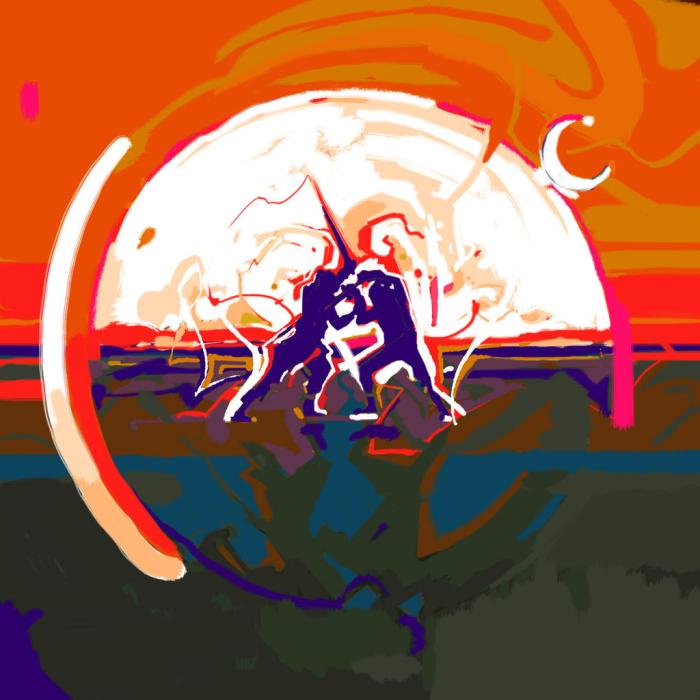
It would have been pleasant, the thought came to him, to be able to lay down their weapons on the darkening grass. To walk away from this place, from what they were being made to do, past the ruins, along the river and into the woods beyond. To find a forest pool, wash their wounds and drink from the cool water and then sit beneath the trees, out of the wind, silent as the summer night came down.
Guy Gavriel Kay, The Lions of Al-Rassan
Not in this life.

Hi, I’m Caylah Coffeen, a freelance editor and marketer of sci-fi and fantasy books. I love reading and writing and am a follower of Jesus Christ.
I’ve worked for Monster Ivy Publishing and Eschler Editing, and am currently a weekly editor with Havok Publishing. Reach out to chat about books and publishing!
Thanks for stopping by my website! I hope you’ve found some helpful resources about reading, writing, and publishing. If you liked this article, here’s some more free content…
- Discover another great bromance in my review of Virtuous Sons by Y.B. Striker
- Send me an email to receive a free sample edit on the first 5 pages of your story
- Subscribe for future posts
Discover more from Creative Cornerstones
Subscribe to get the latest posts sent to your email.

3 thoughts on “Book Review: The Lions of Al-Rassan by Guy Gavriel Kay”