Pursuing True Diversity in Fantasy Books

Guest post by Izaic Yorks

Fantasy as a genre has long captured the imaginations of readers with its thrilling adventures and heroic narratives. But if you’ve spent any time in the trenches of Reddit, BookTok, or even Threads, you’ve likely come across a question echoing throughout the zeitgeist:

Does fantasy suffer from a lack of diversity?

That, however, is the wrong question.

At the heart of this conversation lies a more critical distinction. The real question we should be asking is:

What do we even mean by “diversity”?

Is it simply about including characters of various races and socioeconomic backgrounds? 

Or does true diversity dig deeper? 

This article explores that very question while offering insights into how diversity can (and should) transform the realm of fantasy. Along the way, you might come to love me, or you might come to hate me. But one thing you won’t accuse me of is being a vapid wanderer with nothing but clouds for thoughts.

What Does Diversity Mean in Fantasy?

When we think about diversity in fantasy, what’s the first thing that comes to mind? For many, in a culture increasingly unmoored from classical philosophical foundations, “diversity” is often reduced to outward traits: ethnicity, gender, or socioeconomic status.

And yes, those factors matter.

But they shouldn’t overshadow what truly makes stories vibrant and enduring: diversity of thought. Because a book, at its core, is a well assembled stream of consciousness. A meditation and confrontation with ideas.

Diversity in My Own Career

This subject is actually quite dear in my own author journey and not for the reasons you might suspect. Whenever diversity comes up, it’s often along the lines of: “Hey, Izaic, why don’t you mention you’re Black? That could really help spotlight you or bring money in the door.” Every time I hear that, it feels like an arrow to the heart.

Why? 

Because it screams the bigotry of low expectations. Ideas that stand the test of time are based on merit. To have mine judged by skin tone or assumed hardships might grant me a short‑term dopamine hit but, in the end, would leave me wondering: did I earn X or Y, or was that just the result of someone’s assumption about me?

So, over and over again, I have declined grants or invitations that hinge solely on my skin tone. At times it’s been hard and a challenge to the life of virtue. Undoubtedly I am leaving money on the table, but I have faith that I am more than the base materials of my physical body. What remains, and what is important, is the diversity of my mind and soul, which God made perfectly to His design.

Beyond Biometric Metrics

Reducing diversity to metrics like race, gender, or class oversimplifies a much richer and more vital conversation. Biometric diversity does not automatically guarantee depth or quality in storytelling.

True diversity emerges from exploring nuanced ideas, conflicting beliefs, and different cultural frameworks for understanding universal human experiences.

Imagine a world where fantasy novels challenge readers to see the world differently—to entertain new possibilities and reflect deeply on their own beliefs.

That is authentic diversity.

More Than Skin Deep

Reducing diversity to physical characteristics is a form of tokenism, where characters are included as symbolic gestures rather than meaningful contributors to the narrative.

Instead, let’s consider stories where ideas and beliefs are the defining elements of uniqueness.

For example, a Black author can skillfully craft a European medieval fantasy steeped in knights, castles, and folklore. Likewise, a White author can authentically write a story centered around urban Black youths navigating the challenges of Chicago through the lens of portal fantasy.

The richness of a story stems not from the biometric traits of its characters or creators, but from the depth and clarity of its ideas.

Biological factors ≠ Diversity.

They are merely a potential starting point from which diversity might emerge.

This is not to deny the importance of representation but to elevate the conversation.

Our ultimate goal as lovers of literature should be compelling storytelling that speaks to the human condition. As Dr. Martin Luther King Jr. famously said, what matters most is “the content of their character.”

For fantasy, this means content that challenges, inspires, and transports readers into the vast frontiers of imagination.

The Reader’s Role in Seeking True Diversity

Writers aren’t the only ones responsible for cultivating meaningful diversity. Readers play an equally crucial role in shaping demand for more thoughtful and expansive narratives.

When audiences seek out stories that offer fresh perspectives and complex characters, they help pave the way for a broader, richer literary landscape.

Supporting Authentic Storytelling

Here’s how readers can contribute:

  • Explore New Authors: Seek out voices from various cultural and social backgrounds. But celebrate them not for their skin or heritage—celebrate them for the merit of their thoughts and craft.
  • Foster Conversations: Discuss books with others. Unearth the deeper themes and perspectives within a story.
  • Prioritize Depth: Choose books that offer intricate world-building, moral complexity, and provocative ideas over ones that simply check superficial boxes.

By demanding authenticity and intellectual richness, readers uplift authors and help shape a publishing culture centered on excellence.

Raising the Next Generation of Readers

Creating a culture where diversity of thought thrives doesn’t happen overnight. It begins with nurturing a love for reading in young minds. Exposing children of all backgrounds to a range of high-quality, diverse literature helps expand their worldview and strengthens critical thinking.

How to Foster a Love for Diverse Literature:

  • Start Early: Introduce imaginative fantasy stories that stretch the mind and expose kids to different ideas.
  • Align with Values: Share stories that reflect your core values but don’t avoid those that challenge or stretch them.
  • Create a Rich Literary Environment: Fill homes or classrooms with books spanning genres, cultures, and philosophies.
  • Celebrate Curiosity: Encourage kids to ask hard questions about characters, themes, and conflicts.
  • Train for Excellence: Stop paying lip service to mediocrity. If you’re invested in the future of Black youth—or any youth—invest in their craft. Train them rigorously. Push them to be extraordinary.

A sustained effort to introduce children to rich, diverse storytelling shapes a generation that values both creativity and authenticity. Excellence is the only foundation that ensures diversity lasts beyond trends.

Building a Future of Excellence in Fantasy Literature

Fantasy offers endless room for exploration, creativity, and connection. But for the genre to thrive, it requires intentional effort from writers, readers, and publishers alike.

Christian authors, especially, have a unique opportunity to contribute by anchoring their work in faith and reflecting the boundless creativity of God’s design.

The future of fantasy doesn’t rest on superficial representation. It depends on cultivating excellence and allowing the diversity of ideas to compete in all aspects of storytelling.

And that journey begins now.

With you.

About Izaic Yorks

Yorks spent six years as a professional Track athlete, earning silver in the United States championships, among several other distinguishing awards. Now, he seeks his true passion for authoring fantasy works with a heart for virtues that chase the Good, True, and Beautiful.

​Hailing from the Pacific Northwest, Yorks is now happily lost in Hillsborough, living the small-town life and raising a growing family with his wife Courtney.

Check out his book!

Hi, I’m Caylah Coffeen, a freelance editor and marketer of sci-fi and fantasy books. I love reading and writing and am a follower of Jesus Christ.

I’ve worked for Monster Ivy Publishing and Eschler Editing, and am currently a weekly editor with Havok Publishing. Reach out to chat about books and publishing!

Thanks for stopping by my website! I hope you’ve found some helpful resources about reading, writing, and publishing. If you liked this article, here’s some more free content…

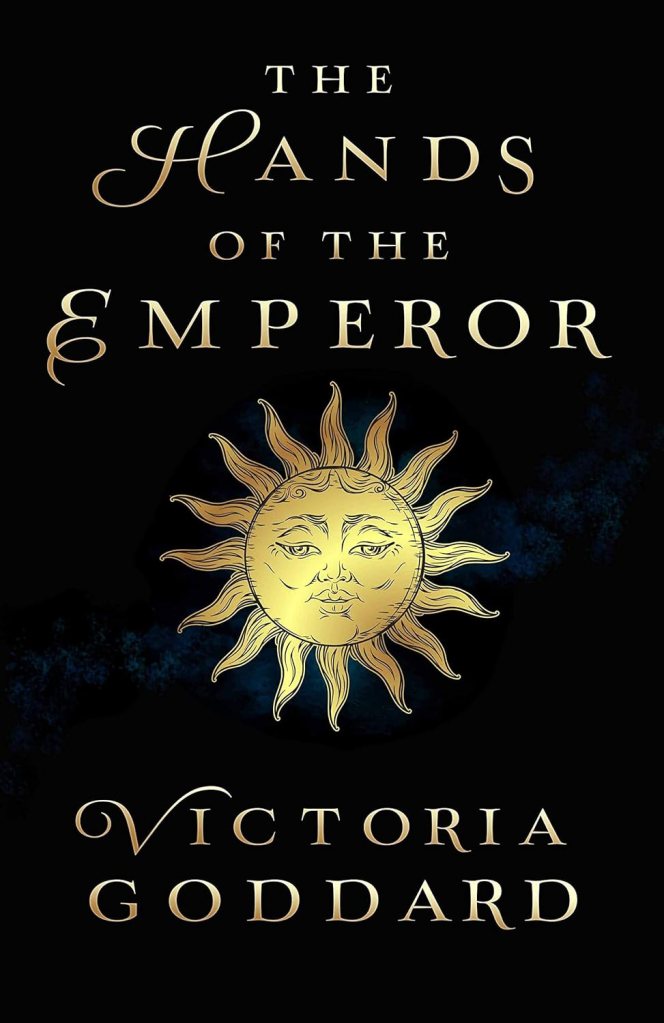
Book Review: The Hands of the Emperor (Lays of the Hearthfire #1) by Victoria Goddard

Summary

Rating: 5 stars!

The Hands of the Emperor is a stunningly wrought tale of mythic friendship, set in a world of wild magic and serendipity, featuring rich diversity, epic cultural traditions, and tear-inducing moments of truth between family.

Synopsis

A magical cataclysm devastated the 5 worlds bound into the Empire of Astandalas, ending the 4000 year reign of the lion-eyed god Emperors. Upon the world of Zunidh, the last Emperor of Astandalas, now reduced merely to the lord magus of Zunidh, attempts to piece back together the magic and order of the world on which he was raised. At his right hand, Cliopher Mdang of the Wide Sea Islanders dismantles the lingering corruption of the Empire, establishing a new government and ushering in an era of peace and prosperity.

He loves his lord dearly, but magical and ritual taboos prevent them from truly being friends. Until Cliopher (Kip), seeing the deep loneliness and despair his lord has buried in his heart, invites him on a vacation to his home in the Wide Seas. His gesture, as simple as it is treasonous, changes the course of their lives and that of their world.

Characters

5/5 stars!

The characters are truly where this book shines! Most of the cast is composed of middle-aged characters, which is such a treat given the preponderance of 17-year-old heroes and heroines out on a bildungsroman. These characters know who they are, are solid in their positions in the world, and yet have half a life of choices and regrets behind them, and a whole world of unfulfilled goals before them. There are more and more layers to peel back as the story continues. Cliopher and the Emperor are the twin stars around which this story orbits, but there is a larger cast of strongly developed characters, including Cliopher’s (widely!) extended family and hometown friends and the other members of the Emperor’s household.

Kip is wicked smart, idealistic, and deeply passionate about his culture’s traditions. He’s one of those people that will-powered himself to the top through audacity and stubbornness, in addition to raw talent. In many ways, though, he’s a man at war with himself. He’s desperate for his family to understand why he’s worked so hard to improve the world but is also terrified of letting the prejudiced see what his heritage truly means to him. I related so deeply to his desperate desire to be asked about himself! His family says things like, “why didn’t you let us know how important you were,” and he says, “Because you told me I was boasting every time I mentioned something I cared deeply about!” I resonated with his deep urge to be seen and accepted for all parts of himself, but unsure of how to claim them all. Above all, he is a loyal friend who will do anything to see his Emperor smile, which is why some people have referred to this as a cozy fantasy, though I would call it a low-stakes political & mythic fantasy.

The Emperor, hereafter known as His Radiancy, as that is the title by which his personal household endearingly refers to him, is traumatized both physically, magically, and mentally due to the isolation and other side effects of his power. It’s heartbreaking to see and so rewarding to learn more about him throughout the story. Even Kip didn’t know him fully, despite spending half their lives together. In this way, it almost reads as a mystery (and there is one – if you know, you know, haha), as we piece together both his and Kip’s personal pasts, and their work to reshape the remnants of an empire.

I absolutely love the humor in this book! All these characters rib each other, often in the most subtle ways (satin anyone?).

“‘Come now, I hear you called him a soft-spoken hypocrite. What did he call you to prompt that?’
Cliopher bit his lip. ‘A reasonable man.’
‘A strike to the heart! My dear Kip, do not look so mulish. I would never stoop so low as to call you reasonable. You are quite the most radical idealist I have ever known-or at least, the only sane one.’”

The Hands of the Emperor
Fanart by @alex_caloen

Plot

4.5/5 stars

Some people have complained that this book has a rather meandering plot. I didn’t mind that, since it is decidedly a character-driven story, not a plot-driven one. I wouldn’t even call it straight political fantasy, since while Kip is essentially the Secretary of State of his whole planet, we mostly see his big picture ideas for changing the world, rather than the nitty gritty day-to-day details. All scenes and actions circle around the relationships between Kip and the Emperor, and Kip and his family. In some ways it can almost feel like slice-of-life.

I’d put it this way: the plot felt unpredictable, yet not unplanned. It feels true to life – surprises happen and throw a wrench in your plans, you have a fight with your oldest friends, get an unexpected visitor, nearly lose someone to an illness, and yet still push forward each day in service to others. And yet all of the mini conflicts and revelations propel the characters toward a unified resolution at the end, which is incredibly emotionally rewarding.

Some of Kip’s later accomplishments stretched my suspension of disbelief (establishing a universal income for an entire planet in about 5 years… and there were no major problems?). But because the story was truly about Kip and His Radiancy’s promises to each other, I pushed such doubts aside. However, the vagueness of the explanations (“Kip had contingency plans in place if things did go wrong”) would likely frustrate readers that are more interested in plot and worldbuilding than bromance.

“I have been fortunate beyond the lot of many men that not only can I, do I, admire and respect my lord and my master, but that I could, that I do, also love him.
My lord, my… Tor… if you were my brother or my cousin I could not love you more.
When you are no longer sitting on the Lion Throne, I would like to know the man behind the Serenity. As a friend.”

The Hands of the Emperor

Worldbuilding

5/5 stars!

What absolutely phenomenal worldbuilding! How rare to find a book that is so incredibly character-focused, yet has such intricately spun magic systems, cultures, traditions, and history! There is so much here, and yet I kept wanting to learn more. Kip’s culture is based around our world’s Pacific Islander culture. I’ve never read a fantasy book like that! So refreshing. There are many uniquely invented cultures too!

The Upper Aristocracy of Astandales feels somewhat like a mix between Roman, Egyptian, and Chinese governance systems, and yet in many ways entirely unique. The rulers are black, descended from both the Sun and Moon, only marry close relatives, and enact a strictly hierarchical system of taboos, blessings, and curses. They conquered and bound their empire together with wild magic yet now employ a rigid schooled magic system. What a delicious set of contradictions and delightfully tormented family history!

I did initially find discussion of “The Fall,” the cataclysmic event which broke the magical connections of the multi-world Empire, to be confusing. The main characters are all intimately familiar with the event, and no one in the world likes talking about it – it was deeply traumatic for everyone. There’s hardly a person who didn’t lose multiple family members and friends in the event, and even time was distorted, causing strange effects on the mind and body in ways even master magicians don’t understand. So basically, the characters are still confused about it, which made me kind of confused about it. The author would mention things like, 100 years ago, or 1000 years ago, so-and-so who’s still alive did x, which had me lost before I realized that time literally broke and who knows why aging didn’t happen.

I was also a bit confused about the world’s level of technology, and which world was which. Characters mention trains, universities, healthcare, and instant mail, but still carry around spears and swords and wear grass skirts if they want. I guess they feel like a 20th century society achieved through magic. The different worlds are essentially planets connected by magic “portals”in-between places,” which wasn’t explicitly stated, so at first I thought the names mentioned were other countries, not entirely separate worlds! But that’s kind of par for the course when it comes to learning about not just one world, and one prior Empire of many worlds, but also about what all those worlds are like after everything broke.

Fanart by @alex_caloen

Writing

4/5 stars

Victoria Goddard’s prose is artful in some places, and surprisingly dense in others. One moment feels like a fairy tale or scene from an old myth, where the gods materialize and issue a challenge in a voice of thunder. Then other scenes felt rather bloated with description, like a pages-long explanation of the structure of the Palace’s throne room. Kip is one of the loremasters of his culture’s oral tradition and lives out their poetry through his actions! He will absolutely walk into a room and declare, “I sing the Wide Seas!” or respond gleefully to the challenge, “Who is this who comes out of the sunrise?” So, in many ways the dialogue of the story is what’s the most artful. His Radiancy also enjoys songs and stories and can be poetic in speech (he is so into it when Kip gets into it, which is utterly adorable).

But at times I felt frustrated that Goddard didn’t go “all in” with the lyrical style and that some passages almost felt journalistic in the way information was conveyed. Yet I also think this was a complex attempt to marry two styles into one, which reflected the character’s personal journey perfectly. After all, Kip is a bureaucrat who has “elevated the report to an art form.” We see him wandering the beach under the full moon, calling upon a goddess’ blessings, and we also see him corralling politicians and writing memos in his office. It would feel strange if the latter scenes were written in a way worthy of an epic. In the second book (minimal spoilers ahead), the plot leans much more toward the mythical, so in turn, so does the writing itself. But I do find myself skipping over some chunks of description when I reread this.

Impact

5/5 stars!

Sometimes, the greater the impact a story has on you, the harder it is to write a book review. It’s a matter of exposing the sticky webs that have woven themselves around your heart and laying them out in order. I fell in love with The Hands of the Emperor on my first read and immediately went on to devour the next 4 books (plus several short stories) in her world! Then I went back and reread my favorite parts of The Hands of the Emperor. Then I fully reread both it and its sequel At the Feet of the Sun.

Each new time, I feel like my heart grows larger as these characters fill my imagination with passion, beauty, and joy. They’re the type of books that richen with each read, revealing more layers to Goddard’s world, the inner lives of these characters, and the philosophies and cultures which define them. The more books you read in life, the harder it is to find a book that truly lights a new spark in your heart (metaphor intended). This is one of those!

“I suppose we always hope that those closest to us can see into our hearts—but unless we invite them, or show them in words or deeds, how can they?”

The Hands of the Emperor

Conclusion

If you enjoy character-driven stories, diverse, sprawling worlds packed with history and magic, deep friendships and found family, and emotional and philosophical conversations, then you will love The Hands of the Emperor! Warning: you will become addicted. Writing this got me all fired up. I need to go read it a fourth time!

You can find books set in the rest of Victoria’s universe on her website! And buying books directly from her site will allow the majority of profits to go to her, not to retailers!

But if, like me, you find it hard to pass up the convenience of Prime, here you go.

P.S. I always advocate supporting authors by buying their books! But for those of you who can’t, I found almost all of Goddard’s books on Hoopla. If your library doesn’t carry them, there is a Discord fan server called the HoTE Support Group and you can request that someone gift you a copy (sub-channel: Crowdfunding the Nine Worlds)! Such a gem of a fandom!


Hi, I’m Caylah Coffeen, a freelance editor and marketer of sci-fi and fantasy books. I love reading and writing and am a follower of Jesus Christ.

I’ve worked for Monster Ivy Publishing and Eschler Editing, and am currently a weekly editor with Havok Publishing. Reach out to chat about books and publishing!

Thanks for stopping by my website! I hope you’ve found some helpful resources about reading, writing, and publishing. If you liked this article, here’s some more free content…