
Guest post by Nicholas S. Casale
As an avid fan of the fantasy genre, I consume fantasy stories any which way I can (novels, television, movies, and video games).
Recently, I had a chance to play the Oblivion remake released by Bethesda. After I finished the main storyline quests, I decided to pick up Skyrim (its sequel) while I was at it. I was surprised at the stark contrast between the two worlds. Where the world of Oblivion is beautiful to behold and full of humorous, even slightly silly characters, Skyrim is harsh and jagged, and full of meaner characters.
That was when it dawned on me what the difference was between the two stories. In Oblivion, the world was worth fighting for. In Skyrim, the world was worth fighting.
I have since noticed that these are the two basic types of fantasy settings: the world worth fighting for and the world worth fighting. When we have a world worth fighting for, it is clear that the world the story takes place in is a good one, and the main character wants to keep it. When we have a world worth fighting, the focus is far more on the main character (or characters), and the way they rise to the challenges that the world throws at them.
We can see this in a few other examples.
Middle Earth is a world worth fighting for, demonstrated most by the Shire and Rivendell. Samwise Gamgee even makes a speech reinforcing this point.
SAM: But in the end, it’s only a passing thing, this shadow. Even darkness must pass. A new day will come. And when the sun shines it will shine out the clearer. Those were the stories that stayed with you. That meant something. Even if you were too small to understand why. But I think, Mr. Frodo, I do understand. I know now. Folk in those stories had lots of chances of turning back only they didn’t. Because they were holding on to something.
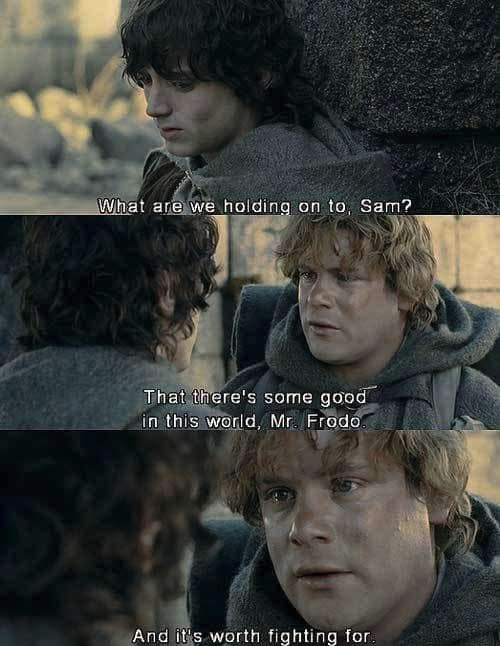
FRODO: What are we holding on to, Sam?
SAM: That there’s some good in this world, Mr. Frodo. And it’s worth fighting for.
Westeros is a world worth fighting. It’s awful, dark, and full of murder and betrayal.
Prydain from the Chronicles of Prydain series is a world worth fighting for. There is beauty in it, and wonderful people. Even some of the more self-serving people are still inclined toward good, and then there are the forces of darkness looking to conquer it.
Warhammer 40K has no bright spot in it, no place where the soul-crushing inevitability of demise hasn’t tainted everything. It is a mad universe where the only constant is war. It is a world worth fighting.
Not Just Grimdark vs. Noblebright
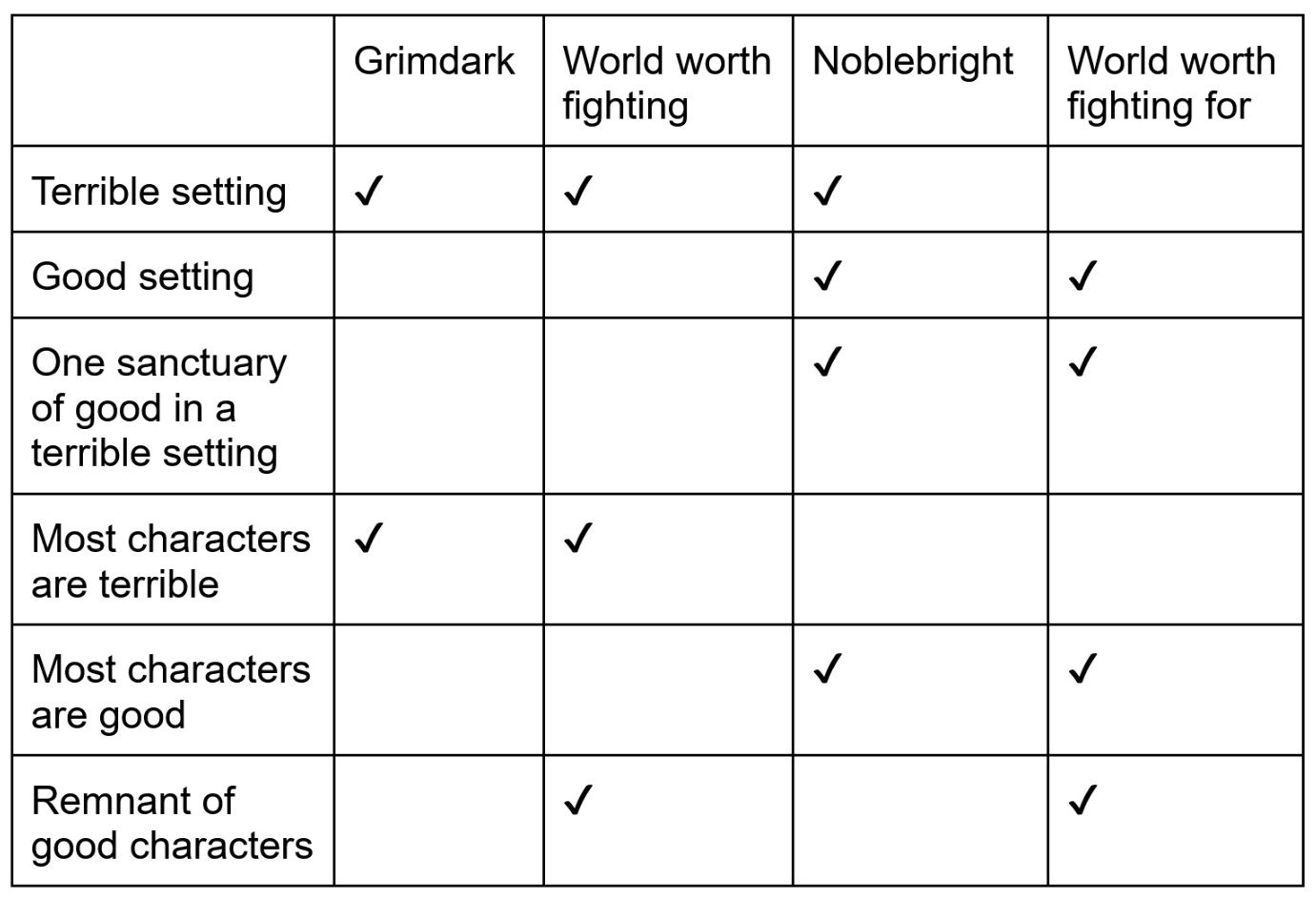
Now, I know that some people will simplify this to being the difference between the Grimdark (what is grimdark?) and Noblebright (what is noblebright?) genres. That is fair, because every Grimdark story’s setting can be summed up as “a world worth fighting.”
However, not every Noblebright story takes place in a world worth fighting for.
Take, for example, Star Wars. I would call Star Wars Noblebright because it features good triumphing over evil, and it is generally pretty clear who the heroes and villains are. Yes, recent stories in the Star Wars universe have brought in more moral ambiguity, but while the heroes may do morally questionably things on occasion, the sheer wickedness of the villains makes it clear that they are the evil ones.
But in the original trilogy, the Empire has control over everything. Making it worse, wherever the Empire doesn’t have control we get hives of scum and villainy, hostile nomadic tribes, monsters, and far-reaching criminal gangs like the Hutts.
Thus, I would argue that the Star Wars setting (true to its name) is a world worth fighting rather than a world worth fighting for. Luke Skywalker doesn’t fight for Tattooine, Yavin 4, or Hoth; he fights for those individuals he loves.
The King Arthur myth gives us a world worth fighting for: Camelot.
Sometimes what determines a world as worth fighting for is something small in it, a specific place. As I mentioned before, Middle Earth has the Shire. Harry Potter’s world has Hogwarts, which, for all its faults, becomes his bastion against the evils of the rest of the world (both the Muggle world and the Wizarding world). In the film Willow, it’s the Nelwyn village, to which Willow wants to return so that he can see his family again.
I would also argue that it could be possible to write a Grimdark story, but make it a world worth fighting for if the hero has some place in it where he can be at peace with his loved ones.
Depending on how you play it, Fallout 4 could be an example of this. The world surrounding the main character is full of mutants, radiation, violent robots, and murderous people. However, in that game you have the option to build places of sanctuary (literally starting with a neighborhood called “Sanctuary Hills”). The sanctuary you build can bring hope to an otherwise desolate wasteland, turning the post-apocalyptic setting into a world worth fighting for.
Where does your story fit?
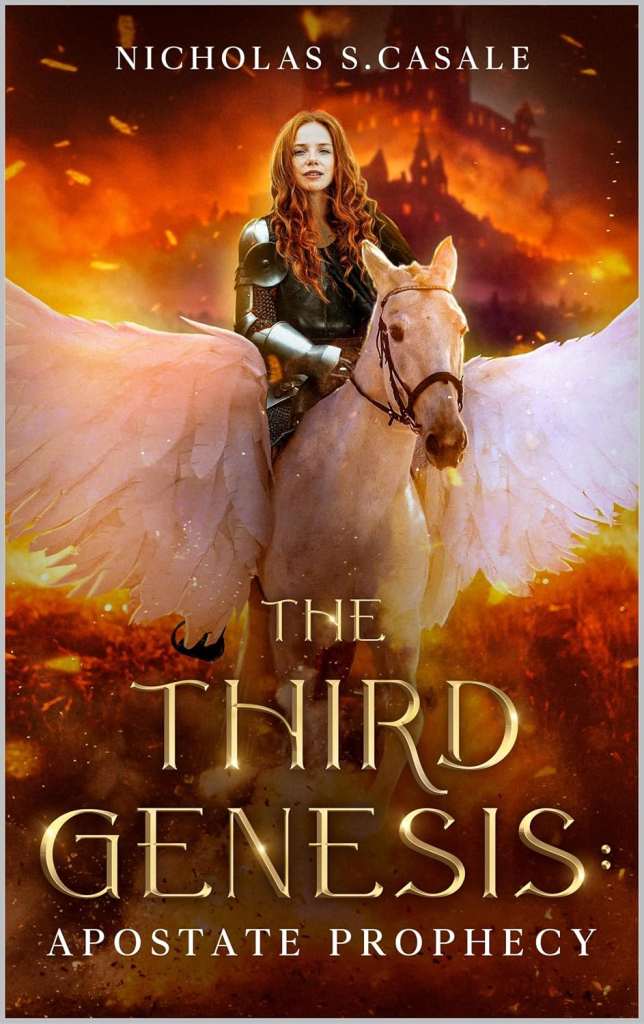
This forced me to take a look at my own epic fantasy series: The Third Genesis. I had to ask myself if the world of Ymir where the story takes place is a world worth fighting or a world worth fighting for.
It is a world where false gods with space age technology have genetically-engineered an ecosystem made up of mythical creatures in order to exploit the planet Ymir’s unique resources. These false gods pit the people and creatures they’ve created against each other, and there are inquisitions, crusades, and holy wars. At first, I thought this made it a world worth fighting. But then I remembered that the people of Ymir live with the promise of the Third Genesis: a day when the false gods shall be defeated and the True Deity, The One, will reign. Thus, I realized that the world of Ymir is a world worth fighting for.
This also got me to examine the Bible to assess the world we live in according to the Good Book. Does the Bible speak of this world as one worth fighting or worth fighting for? While there are many places in Scripture that speak to the corruption of this world, and even places where it is implied that the Devil has dominion over the physical realm, we cannot forget the LORD’s promises of a day when He will wash away that corruption. And we cannot forget John 3:16, the most famous Bible verse of all, “For God so loved the world that He gave His only begotten Son, that whoever believes in Him should not perish but have everlasting life.”
The Supreme Being has declared this world worth fighting for. So, let us do so every day, and ensure that we always follow the orders of our King when we do.
About Nicholas S. Casale
Nicholas is a prolific author who has written mostly westerns, but his true passion is for fantasy novels. Starting from the age of six (with stories about a mouse wizard named “Mousey”), he has honed his craft through years of dedicated writing.
His studies in history, religion, mythology, folklore, and classical literature have informed his works. Each of Casale’s works hit emotional notes and raise fascinating questions about the nature of life, love, morality, and existence.
Try Casale’s Fantasy Novel

Hi, I’m Caylah Coffeen, a freelance editor and marketer of sci-fi and fantasy books. I love reading and writing and am a follower of Jesus Christ.
I’ve worked for Monster Ivy Publishing and Eschler Editing, and am currently a weekly editor with Havok Publishing. Reach out to chat about books and publishing!
Thanks for stopping by my website! I hope you’ve found some helpful resources about reading, writing, and publishing. If you liked this article, here’s some more free content…
- Explore what makes a character worth fighting for in my post “Why Your Main Character Falls Flat: Do They Think About the Big Questions of Life”
- Send me an email to receive a free sample edit on the first 1000 words of your story
- Subscribe for future posts
