Do you know that feeling when you pick up a book and absolutely devour it, sucking it in like you’re feeding a gaping maw within your chest? And then you tear through the next few books trying to satisfy the same clawing yearning.
Then one day, your thoughts wander. You feel restless and when you open Kindle, forget that you had started the book staring at you. The words had slipped out of your mind. Scenes and dialogue fill your mind. A song catches your imagination and before you know it, it’s 2 am and you’re pacing, caught up in a battle or a scheme between characters. Before you know it, you have an entire new backstory, planet, or subplot that’s run away with you.
But then, as quickly as the flood of ideas came, they ebb away. You don’t feel like doing anything but watching TV or reading brain candy – your comfort fiction. That itch is back again that you need to satisfy, and the hunt is on for a book that will touch your heart or mind.
The Creative “Input-Output Cycle”
I call this the creative “input-output cycle.”
All creatives need a mix of input to stimulate their minds, imagination, and emotions. Without craft to emulate, ideas to inspire, and experiences to wake us, our creative well will remain dry.
Some authors can even name the story that “woke them” or tapped the buried flow of water, making it rush into and fill the well. For me, it was the chapter book series The Secrets of Droon by Tony Abbott (#myfirstedgelord) which my mother gifted to me for Christmas in 2nd grade. My parents had already cultivated a love of reading in me, but from that moment onward, I devoured books ravenously for 4 years: horse books, mystery, historical fiction, classics, and above all else, fantasy.
Then, the well overflowed, and stories started spawning in my brain. I couldn’t hold them in. They distracted me from my homework. I would spend hours daydreaming at my desk, incapable of reading because my brain had synthesized too much (no such thing), and now had to express itself.
Have you ever heard this quote?
Q: Why do you write? A: Because I have to.
It’s not a choice, it’s a compulsion. Just as reading becomes as necessary as breathing, as vital as food for the mind, heart, and soul, so too does creation.
As C.S. Lewis said in Till We Have Faces, “I was with book, as a woman is with child.”
Input Begets Output, Output Crowns the Soul
I’ve always been confused by writers who say they struggle to come up with ideas for their next book. I’ve always had the opposite problem. In fact, the plethora of ideas makes it hard to choose where to start my stories, which could fill dozens of books (according to my outlines).
I can’t read a book, listen to a piece of music, or watch a movie without new ideas blossoming in my mind. I remember the exact moment one of the main characters of my sci-fi universe popped into my head. I was sitting in my room in my senior year of high school, reading the first chapter of Hyperion by Dan Simmons. My main character positively exploded into my mind, thereafter occupying my every waking, and sometimes sleeping, thoughts.
It’s painfully obvious when a writer is unfamiliar with storytelling. When I review a sample that makes me suspect a reading deficit, I usually suggest this exercise – I ask them to pick a couple of their favorite books and rewrite a passage of their work in each style. The answer is usually, “oh… I’m not sure. I don’t really read much.”
Can an artist learn to paint even if they’ve never set foot in an art museum? Yes. Can a musician compose even if they hardly ever listen to music? Yes.
But they might as well be half blind and half deaf in their endeavors. Our brains need stimulation to form new networks, patterns, and understanding. If you are having trouble writing, then read! I know you’ve heard this. Reading is the most important form of input for a writer, but other creative inputs are also vital – art, music, dancing, religious experiences, travel, and so on.
But the opposite is also true. You could be in a reading slump, slightly irritated at everything you pick up, because nothing quite seems to touch that deepest place within your soul. These days, it’s actually easy for our brains to become oversaturated with input – that might be your problem.
If you’re having trouble writing, it might be because you’ve had too much input, and of the wrong type. Imagine again our well of creativity. If you’re constantly tapping into various underwater streams, you could end up with a geyser of Kool-Aid that turns your creative landscape into a nasty sludge of punch, rather than a full well of spring water that you can dip into and disperse with control.
It might be time for some quiet. Let your mind digest everything you’ve consumed and settle. Go back and savor one course a bit more deeply. Your original ideas might be fighting to emerge from the roiling stream of external ideas you keep cramming into yourself.
And what you add to the world’s body of stories will be your crowning achievement, standing atop all you’ve uniquely experienced.
Finding a Creative Balance
Finding the right balance of input and output takes time. In my experience, the right combination has also varied depending on my life circumstances. Sometimes poor mental health led to an abundance of my own stories as a form of emotional expression, while other times I drowned out my own thoughts with other peoples’ stories. New experiences sometimes compel me to add a new facet to my world, while other times curiosity inspires me to read and research a ton about that experience just for the sake of learning.
I’ve come to listen to myself and notice the type of restlessness and frustration I feel when my mind is ready to shift from one part of the creative cycle to the next. When I’ve spent several days reading the first few chapters of a dozen books, with none managing to capture my interest, I’ll start to poke at my own worldbuilding and outlines instead. When I start rewriting the same scene in my mind in every possible iteration till it feels like I’m beating a dead horse, I’ll return to my TBR list, often picking something completely different from the story I’d been working on to shake my brain loose.
I’ve spent months to years in an “output” cycle as my stories rapidly expanded, barely watching or reading anything in that time. But recently, I “cycle” more rapidly, reading multiple books in a few weeks, then switching back to scene development for a couple weeks, and so on.
Name Your Process… and Feel Less Insane
I come from a big family (7 kids!) and over half of us love to write. When we started to articulate our process like this, it helped us understand each other and ourselves so much better. It also helped our non-writer relatives and friends understand our “crazy” a bit better!
Sis: Hey, do you want to watch Stargate? Me: Nah, not tonight. Sis: Aww, you said that last weekend, come on! Me: I know! But I’ve been in output mode. I can’t get this scene out of my head. I just need to get it down!
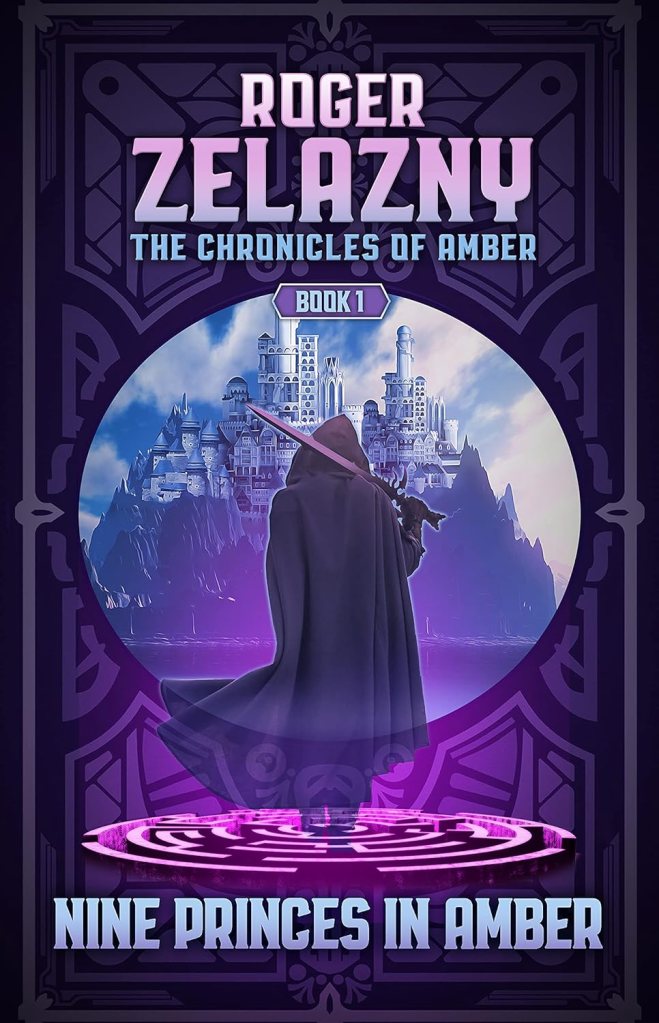
Me: Hey, how are your stories going? What have you been working on recently? Sis 2: Ah, I felt kind of stuck on that one character. It was really annoying me so I stopped working on it for a while. I must’ve read at least 5 Mercedes Lackey books in the past week though! Me: Nice! I’ve been in input mode too. I picked up Nine Princes in Amber and now I’m trying to get my hands on everything Zelazny ever wrote.
Giving yourself permission to take a break and just enjoy stories can be hugely relieving! Not to mention practical for building both empathy and craft skills.
It can be harder to notice when you’re oversaturated and need to take a break to let your own ideas bubble to the surface, but this is also a practice that will greatly benefit your creative process in the long run.
There’s no right or wrong way to balance an “input-output cycle.” You could write in the morning and read in the evening, or vice versa. You could write all day on the weekends and read your comfort fics during the work week. Or if you’re chasing down a deadline, you could do nothing but bang out that draft for several months, and then go on a binge afterwards.
But naming where I am in my creative cycle and discovering what helps me transition between “input mode” and “output mode” has been hugely helpful to me in sustaining both the development of my stories and a well-read mind.
How well do you know yourself? Are you in control of your creative “input-output cycle?”
Hi, I’m Caylah Coffeen, a freelance editor and marketer of sci-fi and fantasy books. I love reading and writing and am a follower of Jesus Christ.
I’ve worked for Monster Ivy Publishing and Eschler Editing, and am currently a weekly editor with Havok Publishing. Reach out to chat about books and publishing!
Thanks for stopping by my website! I hope you’ve found some helpful resources about reading, writing, and publishing. If you liked this article, here’s some more free content…
As an avid fan of the fantasy genre, I consume fantasy stories any which way I can (novels, television, movies, and video games).
Recently, I had a chance to play the Oblivion remake released by Bethesda. After I finished the main storyline quests, I decided to pick up Skyrim (its sequel) while I was at it. I was surprised at the stark contrast between the two worlds. Where the world of Oblivion is beautiful to behold and full of humorous, even slightly silly characters, Skyrim is harsh and jagged, and full of meaner characters.
That was when it dawned on me what the difference was between the two stories. In Oblivion, the world was worth fighting for. In Skyrim, the world was worth fighting.
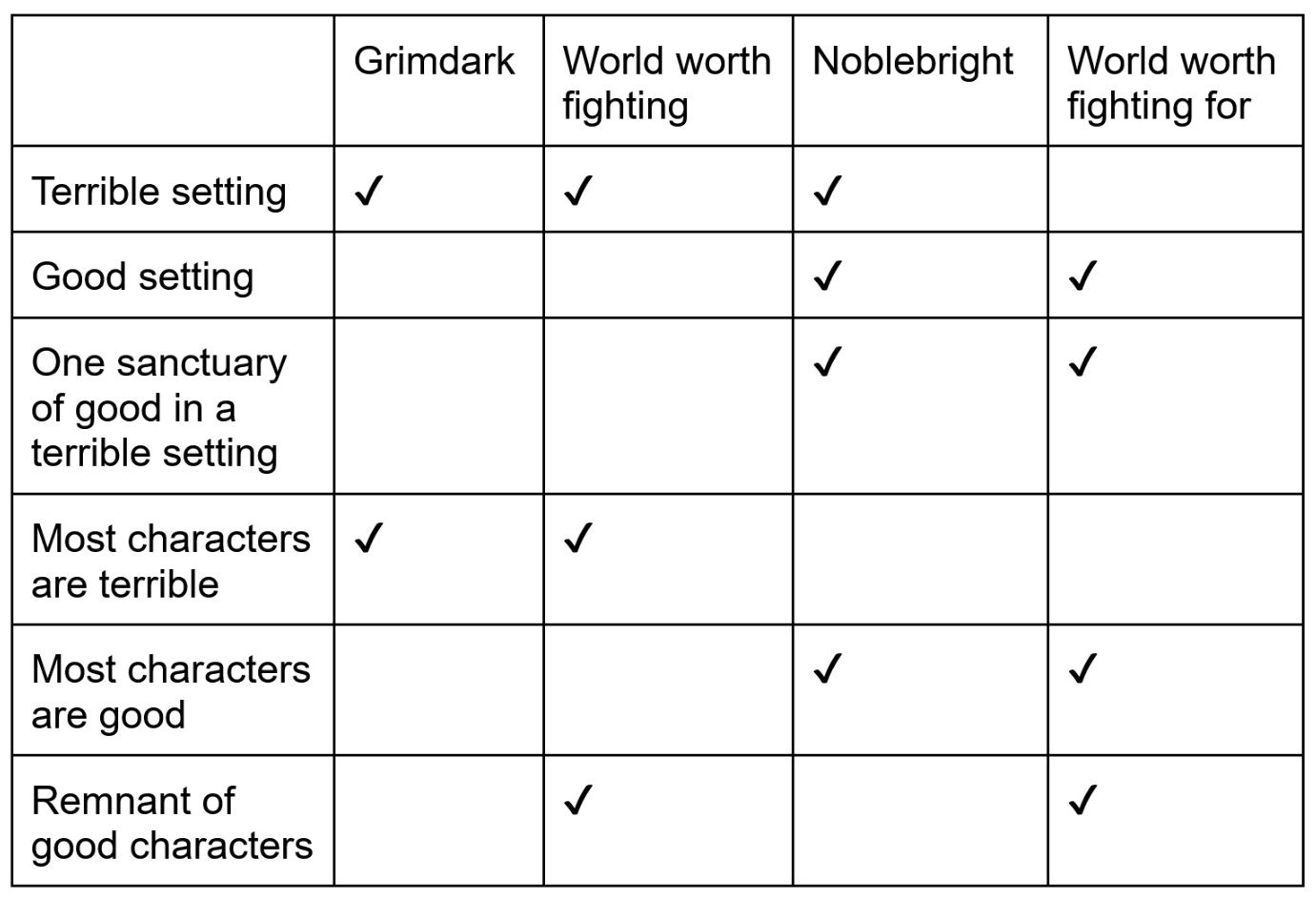
I have since noticed that these are the two basic types of fantasy settings: the world worth fighting for and the world worth fighting. When we have a world worth fighting for, it is clear that the world the story takes place in is a good one, and the main character wants to keep it. When we have a world worth fighting, the focus is far more on the main character (or characters), and the way they rise to the challenges that the world throws at them.
We can see this in a few other examples.
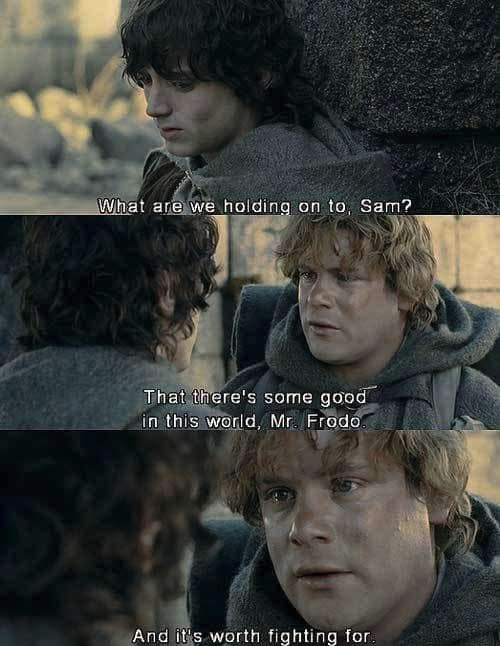
Middle Earth is a world worth fighting for, demonstrated most by the Shire and Rivendell. Samwise Gamgee even makes a speech reinforcing this point.
SAM: But in the end, it’s only a passing thing, this shadow. Even darkness must pass. A new day will come. And when the sun shines it will shine out the clearer. Those were the stories that stayed with you. That meant something. Even if you were too small to understand why. But I think, Mr. Frodo, I do understand. I know now. Folk in those stories had lots of chances of turning back only they didn’t. Because they were holding on to something.
FRODO: What are we holding on to, Sam?
SAM: That there’s some good in this world, Mr. Frodo. And it’s worth fighting for.
Westeros is a world worth fighting. It’s awful, dark, and full of murder and betrayal.
Prydain from the Chronicles of Prydain series is a world worth fighting for. There is beauty in it, and wonderful people. Even some of the more self-serving people are still inclined toward good, and then there are the forces of darkness looking to conquer it.
Warhammer 40K has no bright spot in it, no place where the soul-crushing inevitability of demise hasn’t tainted everything. It is a mad universe where the only constant is war. It is a world worth fighting.
Not Just Grimdark vs. Noblebright
Now, I know that some people will simplify this to being the difference between the Grimdark (what is grimdark?) and Noblebright (what is noblebright?) genres. That is fair, because every Grimdark story’s setting can be summed up as “a world worth fighting.”
However, not every Noblebright story takes place in a world worth fighting for.
Take, for example, Star Wars. I would call Star Wars Noblebright because it features good triumphing over evil, and it is generally pretty clear who the heroes and villains are. Yes, recent stories in the Star Wars universe have brought in more moral ambiguity, but while the heroes may do morally questionably things on occasion, the sheer wickedness of the villains makes it clear that they are the evil ones.
But in the original trilogy, the Empire has control over everything. Making it worse, wherever the Empire doesn’t have control we get hives of scum and villainy, hostile nomadic tribes, monsters, and far-reaching criminal gangs like the Hutts.
Thus, I would argue that the Star Wars setting (true to its name) is a world worth fighting rather than a world worth fighting for. Luke Skywalker doesn’t fight for Tattooine, Yavin 4, or Hoth; he fights for those individuals he loves.
The King Arthur myth gives us a world worth fighting for: Camelot.
Sometimes what determines a world as worth fighting for is something small in it, a specific place. As I mentioned before, Middle Earth has the Shire. Harry Potter’s world has Hogwarts, which, for all its faults, becomes his bastion against the evils of the rest of the world (both the Muggle world and the Wizarding world). In the film Willow, it’s the Nelwyn village, to which Willow wants to return so that he can see his family again.
I would also argue that it could be possible to write a Grimdark story, but make it a world worth fighting for if the hero has some place in it where he can be at peace with his loved ones.
Depending on how you play it, Fallout 4 could be an example of this. The world surrounding the main character is full of mutants, radiation, violent robots, and murderous people. However, in that game you have the option to build places of sanctuary (literally starting with a neighborhood called “Sanctuary Hills”). The sanctuary you build can bring hope to an otherwise desolate wasteland, turning the post-apocalyptic setting into a world worth fighting for.
Where does your story fit?
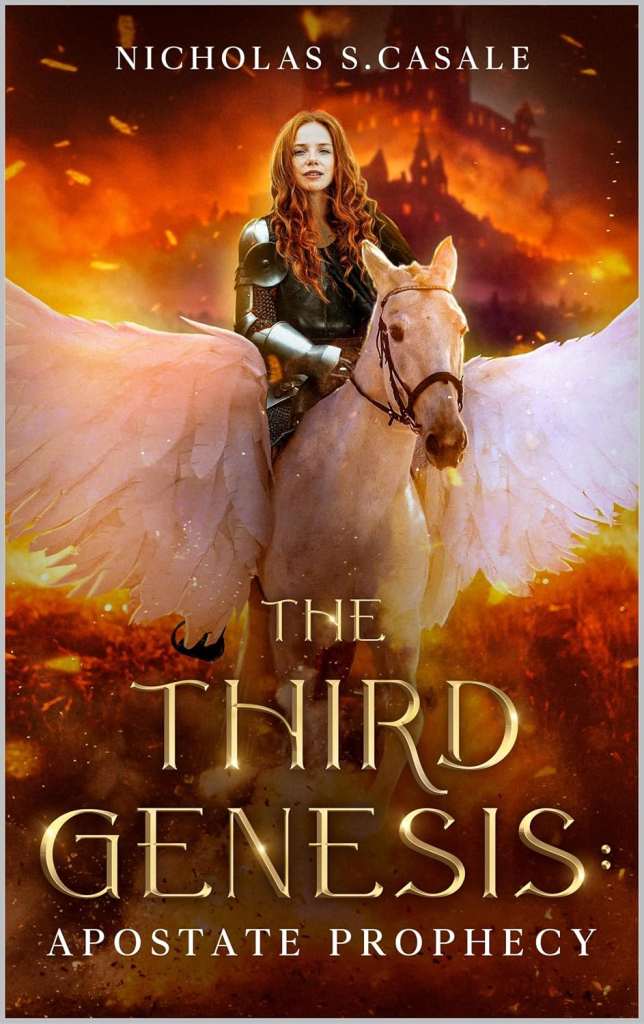
This forced me to take a look at my own epic fantasy series: The Third Genesis. I had to ask myself if the world of Ymir where the story takes place is a world worth fighting or a world worth fighting for.
It is a world where false gods with space age technology have genetically-engineered an ecosystem made up of mythical creatures in order to exploit the planet Ymir’s unique resources. These false gods pit the people and creatures they’ve created against each other, and there are inquisitions, crusades, and holy wars. At first, I thought this made it a world worth fighting. But then I remembered that the people of Ymir live with the promise of the Third Genesis: a day when the false gods shall be defeated and the True Deity, The One, will reign. Thus, I realized that the world of Ymir is a world worth fighting for.
This also got me to examine the Bible to assess the world we live in according to the Good Book. Does the Bible speak of this world as one worth fighting or worth fighting for? While there are many places in Scripture that speak to the corruption of this world, and even places where it is implied that the Devil has dominion over the physical realm, we cannot forget the LORD’s promises of a day when He will wash away that corruption. And we cannot forget John 3:16, the most famous Bible verse of all, “For God so loved the world that He gave His only begotten Son, that whoever believes in Him should not perish but have everlasting life.”
The Supreme Being has declared this world worth fighting for. So, let us do so every day, and ensure that we always follow the orders of our King when we do.
Nicholas is a prolific author who has written mostly westerns, but his true passion is for fantasy novels. Starting from the age of six (with stories about a mouse wizard named “Mousey”), he has honed his craft through years of dedicated writing.
His studies in history, religion, mythology, folklore, and classical literature have informed his works. Each of Casale’s works hit emotional notes and raise fascinating questions about the nature of life, love, morality, and existence.
Hi, I’m Caylah Coffeen, a freelance editor and marketer of sci-fi and fantasy books. I love reading and writing and am a follower of Jesus Christ.
I’ve worked for Monster Ivy Publishing and Eschler Editing, and am currently a weekly editor with Havok Publishing. Reach out to chat about books and publishing!
Thanks for stopping by my website! I hope you’ve found some helpful resources about reading, writing, and publishing. If you liked this article, here’s some more free content…
Sometimes beta readers and reviewers say things like “I just didn’t resonate with the main character” or “The protagonist was nothing special,” despite the many hours and years you’ve spent paining over every one of their thoughts, choices, and words.
So what makes some characters feel forgettable, while others move the hearts of generations of readers? The fact is, characters need more than a driving goal, intricate backstory, and unique strengths and weaknesses in order to truly feel alive. A good horse has most of those things.
If you want your mc to feel deeper than an animal, they need to ponder and act upon matters of “eternal significance,” whether they fall on the side of good or evil. Let’s look at how and why:
The go-to character development checklist doesn’t cut it
When fleshing out a character, particularly the main protagonist, authors have a list of elements they (should) develop:
Deepest want or need
Backstory
Strengths
Weaknesses
Likes and dislikes
Unique behavioral patterns or personality traits (quirks)
Style of speech
These are all important and go a long way in helping readers root for and emotionally connect to a character. But they are still pretty surface level. They’re the bones and muscles, but readers still need the heart and soul.
With the exception of the “deepest desire” or any hidden traumas, you probably know all of those things about your coworkers. Their career and family goals, where they grew up, whether they prefer coffee or soda, if they’re a morning person or obsessed with x sports team, and a whoooole list of weaknesses! 😉
But does this make you feel close to them? Do you really know your coworkers even if you are familiar with their irritating and endearing manners of speech and their drama with their in-laws?
Even if they are the type to gush too much information and you do learn their greatest goals and personal traumas, would you be able to say you “truly” know them?
What’s missing from “flat” characters?
You know the joke (that’s unfortunately not a joke at all): don’t discuss politics or religion at Christmas dinner.
Noticeably absent in workplace and family small talk AND the above character checklist, are topics of “eternal significance.” Do you know what your coworker thinks and feels about the big questions in life? Have you written your main character in a way that will make your reader understand what they believe about what is good, true, and beautiful in the world? Or with only enough depth that readers will know your characters as well as a coworker.
Let’s take a step back. Do your characters actually consider these things? Do they have a well developed inner moral compass, ideology, and active mental world? For some characters, ambivalence is actually part of who they are. Perhaps part of their developmental arc involves learning how to care about more than just themselves. But if you have not deliberately written your character to be shallow, then you need to deliberately develop their spiritual and intellectual world, not just their emotional and plot-relevant one.
Now, let me say straight off that there’s a difference between being shallow and being uneducated. Many fantasy main characters begin as average peasants. Medieval farmers didn’t have much opportunity to learn philosophy or art history. That doesn’t mean they can’t consider meaningful questions and cultivate a life of virtue according to their values.
Where do we come from? What happens when we die?
What truly makes life meaningful?
Should I seek to make the world a better place or merely live as if there’s no tomorrow?
Is there any point to choosing good in such a terrible world?
Real people have opinions on almost everything. There’s always a deeper ideology underneath every quirk.
Your character may find embellished clothing distasteful and dress beneath their means as a result. What’s their underlying deeper held truth? A lingering resentment for the wasteful indulgences of the wealthy? Discomfort in their own body and self-image? Subconscious prejudice against the foreign styles that have started to dominate their culture?
Do you know the answer to that question? Does your character?
A stoic, determinedly plain hero is a trope. We get a sense of who and what they are, but not why or how. As a result, they come across the same as every other purposely understated hero in fiction. This behavior does not end up setting them apart, because the details are only surface level.
For a character to truly have complex depth, they need to think and care about significant moral, social, political, and religious topics, AND act according to the conclusions they have drawn.
The few “big questions” most characters do ask
Now, a lot of main characters in sci-fi and fantasy do address “big questions,” but usually only the same handful:
The right way to treat your fellow human
The morality of killing
How the powerful should treat those beneath them (essentially their philosophy of governance)
The existence of a higher power
Fantasy heroes almost always have to decide where they fall on the lawful good to chaotic evil chart, where they draw the line in their efforts to defeat their enemies, what type of rulers they will follow or stand against, and if a greater spiritual or magical power impacts their life.
I rarely see any moral or philosophical insights beyond these 4 topics.
Do I toss a coin to the street orphan or ignore them?
Should I kill the villain or not? Can I torture him first or not?
Am I honoring my oath more by supporting the peasant revolt or the authority of the local noble who was a family ally?
When my loved ones die, will I see them again in Valhalla or not?
We also usually see the mc’s practical opinions on sex and relationships.
Why they’re not enough
The topics of life and death, power and rulership, God and the afterlife, and moral behavior may seem to give your story and character depth. But if you stop to think about it, these questions are really very basic.
A 10 year old asks them:
Should I be nice or a jerk?
Can I hit someone to stop them from hitting my sister?
Is it ok for teachers to be mean to students?
Is God real?
I rarely encounter main characters in modern fiction whose view is any more refined than that of a ten year old. Another assassin who has nightmares about those he’s killed. Another paladin who pains over whether to stand against the tyrant king he was meant to serve. Another spunky farm girl who refuses to be sold off in marriage by her callous relatives.
Adding other character details like “she obsessively loves potatoes” or “he makes really terrible puns all the time” will make a character feel a bit more unique. But it’s still like adding trimmings to white bread. There is little substance at the heart of such characters.
It’s almost jarring reading older fiction and seeing how differently characters used to be written. Characters would regularly and casually discuss matters of great significance on a wide range of topics – art and music, foreign engagement, social dynamics and etiquette, what makes a superstition legitimate or folly, etc. They clearly have a deeply developed mental (and often spiritual) world that actually affects their day to day existence.
They aren’t the type of people who, when asked a question about people, God, the world, politics, money, stories, or really anything, would shrug and say, “who cares?” or “whatever” rather than pausing to think about it and align their choices accordingly.
Rebuttal 1: “Peasants aren’t deep.”
Now, I admit that older novels were almost predominantly written by and about the middle and upper classes (Austen, Defoe, Dumas, Lewis). The 3 older books that I recently read, and which struck me in their moral and intellectual depth, are The Railway Children by Edith Nesbit, A Picture of Dorian Gray by Oscar Wilde, and The Man Who Was Thursday by G.K. Chesterton. All are about members of the British middle and upper classes.
That’s one reason why Charles Dickens, Mark Twain, Victor Hugo, and Harriet Beecher Stowe were so hugely impactful. For the first time, authors started writing from the perspective of the (very) poor, and showed them to have deeply valuable lives and richly developed character and beliefs, irrelevant of their opportunity or education.
A fantasy or sci-fi novel that follows a farmer, scrapper, or orphan can still contain complex ideas, rich moral underpinnings, and discussions that peel back layers of the human condition.
Rebuttal 2: “Teenagers aren’t deep.”
Young adult books, and YA characters specifically, have gained a reputation for being somewhat shallow, if entertaining, flashes in the pan. Fun to read, but with little staying power. The mc’s tend to be impetuous, emotional teenagers who are often designed as “reader inserts,” deliberately lacking any true distinguishing features.
So you might be thinking, “it’s not that SFF doesn’t have deep characters. It’s that YA SFF doesn’t – so go read adult fiction.”
It’s true that teenagers haven’t had as much time to develop “life wisdom” and their hormones might be driving them to think that their crush smiling at them is “the meaning of life.” We’re not getting married at 15 anymore, so we aren’t in as much of a rush to wise up. But that doesn’t mean young adults should be portrayed as predominantly insolent, impulsive, horny twerps who happen to be able to save the world.
That’s insultingly reductive. A lot of juvenile fiction from the 20th century shows children with a far more developed moral compass and uprightness of character than 21st century books about teenagers. And plenty of the characters in modern adult fiction feel like empty shells. Youth guarantees vapidity no more than age assures wisdom.
Rebuttal 3: “SFF isn’t/doesn’t need to be literature.”
You may also protest, “but fantasy is meant to be entertaining! If you want deep topics, go read serious literature.” Except I vehemently disagree that fantasy and science fiction cannot be “serious literature.” Just take a look at some of the most enduring and impactful books of all time: the Bible, Homer, Shakespeare, Brave New World, fairy tales, H.G. Wells, and so on. All contain spiritual and speculative elements.
This doesn’t need to be a case of “either/or:” depth of content does not eliminate entertainment value. Homer and Shakespeare were both the “Hollywood” of their day. The reason they have endured is because they’re epic, hilarious, fun AND meaningful.
So yes, I expect more of fantasy and sci-fi books today. I look for more in their protagonists. Because fantastical stories have the capacity to catch and hold the imagination of the world for millennia.
Rebuttal 4: “Morals can be shown through emotions.”
It’s perhaps worth noting that the way many define and develop their ideology and morality has changed significantly over the past few decades alone. With the rise of postmodernism came the belief that right and wrong is “whatever you want it to be.”
Modern individuals often choose their actions and beliefs based off how they feel, rather than through a pattern of philosophy or religion. So authors may think, “but I am showing what my characters believe – by showing how they feel and how they act on those feelings – not by lengthy discussions or periods of introspection.”
Unacceptable. Civilizations cannot stand upon a cloud of morals precipitated by fleeting feelings. Postmodernism is a fundamentally self-contradictory religion. It essentially gives people permission to be shallow – nothing but mammals. Why think about anything significant? Just go along with what you want in the moment. I’ve read stories about literal animals (Watership Down, The Tale of Despereaux, Redwall, Warriors, Mistmantle) who deal with matters of eternal significance more than many contemporary human characters.
Characters who side with the slave revolt because they feel angry about cruelty are no “deeper” than characters who don’t care but side with the slave revolt for money. Why is it wrong? “Because I don’t like it…” What if they start liking it? Does that suddenly make it right?
If your characters just let themselves be blown whichever way suits them, whether for money, survival, or the self-satisfaction of their feelings, then they are certainly no different from many humans, but since when did we start writing stories about “just any” humans?
This isn’t grade school where everyone gets a participation trophy for being average. People write memoirs about exceptional people, or about everyday people who chase after something exceptional. Memoirs about lackluster Joe Schmoe wouldn’t sell, so why do authors think fantasy books about lackluster Joen Sch’moex should?
To be called a hero, to deserve being the main subject of a tale, your characters need to pursue the values, ideas, and dynamics in life that make us more than animals.
If beta readers and reviewers keep saying things like “I just didn’t relate to this character” or “The mc wasn’t really memorable” consider taking a deep look at your mc’s mental and spiritual pillars – then build them deeper and higher!
Hi, I’m Caylah Coffeen, a freelance editor and marketer of sci-fi and fantasy books. I love reading and writing and am a follower of Jesus Christ.
I’ve worked for Monster Ivy Publishing and Eschler Editing, and am currently a weekly editor with Havok Publishing. Reach out to chat about books and publishing!
Thanks for stopping by my website! I hope you’ve found some helpful resources about reading, writing, and publishing. If you liked this article, here’s some more free content…
Books with multiple (3+) points of view (POV) have become increasingly popular in the past couple decades, especially in massive fantasy epics and sci-fi. But there are multiple problems with this style that I commonly encounter as a book editor.
The technique is not wrong in and of itself. Every method of storytelling comes with its own pitfalls. The practice of writing novels with multiple points of view in third person is still relatively new, so authors have had fewer exceptional, “classic” examples upon which to base their style.
Now that editors have a larger body of work to analyze, it’s our job to guide authors to improve the way they tell their stories. So I’ll explain these top 11 problems that I see in manuscripts (and published books) with multiple points of view, and offer suggestions for how to avoid them:
I’ll be expanding each point into a full article with more detailed advice on how to avoid each pitfall in your own writing. Part 1: Harder to Hook is already complete – stay tuned for the full series!
1. Difficulty Hooking Readers
With every major point of view character, authors must check off all the same boxes: establish the status quo, show the individual’s wants and needs, give readers a reason to root for them, and spark off their story with an inciting incident.
With only one POV, authors can achieve many of these benchmarks within the first few chapters. This period of time is vital to securing reader interest. If you can’t catch them within this time, most readers will stop reading.
But with each new POV, authors wipe the reader’s emotional slate clean and start all over again. Readers may be interested at the end of the first chapter, but suddenly they’re faced with another stranger that vies for their investment all over again. Then a third. God forbid 4 or more.
It could take an hour of reading to get back to the first character, at which point all the emotional tension has faded and readers have to restart in their efforts to connect with the character.
If a reader only has the mental energy to read 3 chapters, a book with 1 POV has an advantage. 3 chapters is enough time for a reader to build a solid emotional connection to one character. On the other hand, if each of the first 3 chapters is written from a different perspective, after the same amount of reading time, that reader will only have just met each character, not had enough time to get to know them much at all.
How to avoid this problem: As an editor, I find that it’s more effective to group multiple chapters from 1 POV together rather than switching every chapter. It lets readers more deeply immerse themselves in one character before moving on.
Read more about how multiple POVs affect the opening hook of a novel in my full article.
2. Skewed Story Pacing
This is THE biggest problem I encounter in books with multiple point-of-view characters – messed up pacing at the book-wide level.
Say you have 3 POV characters – you’re basically writing 3 books at once and combining them into the same package. This means you’re asking your readers to endure a first act that’s three times as long as usual.
Often, the first act is the least interesting part of a story. In sci-fi and fantasy in particular, there’s often a lot of travel and exposition about the world, races and species, magic system, etc.
Readers are waiting for the moment when something changes. But with three characters, they have to wade through 3 times as much “intro content” before they get to the “interesting stuff.”
A first act usually takes up about the first third of a book. So reading the first act of a book with 3 POVs can feel the same as reading the length of an entire book that only contains first act content.
This is especially problematic if all of the characters have extremely similar situations. For instance, one farm boy trekking across the country to live out his destiny can be repetitive enough, let alone if all your mc’s start out as average joes who undertake a long journey.
How to avoid this problem: Choose POV characters whose arcs complement and contrast one another, rather than being too repetitive or seemingly unrelated (e.x. on opposite sides of the world and won’t meet for several books). Don’t be afraid to introduce some POVs much later in the book or series.
3. Skewed Chapter Pacing
Pacing is most obviously affected at the larger story level, but also at the chapter level. Often, writers are advised to “start late and end early,” but I find that books with many POVs both start and end their chapters too early.
Every time an author switches POV there is a “reset” of sorts. They need to reestablish where the character is, what they’ve been doing since the last time the reader followed them, and how much time has passed.
As a result, the start of each chapter can feel slow and exposition heavy. It’s difficult to use en media res if it’s been 100 pages since your reader last saw this character. It can take a while to build back up to a higher level of energy or greater level of intellectual and emotional intimacy.
But then, because the pacing of these books can feel bloated, authors try to end their chapters on a “snappy” note to avoid boring their readers. So they choose to end a scene too early, sometimes in the middle of the conflict they spent an entire chapter building towards.
This can leave readers feeling like “things were just getting good again” when the POV changed, resetting everything all over again!
How to avoid this problem: If you’re worried that readers won’t push through the next 100 pages unless you end a beat too early every time, you need to face the larger problem – whether that content should actually be trimmed. Authors have learned effective tactics to keep people binge-reading. But that won’t keep readers from noticing – after they’ve put down the book – that they didn’t actually enjoy “getting through” a lot of the in-between content, even though they felt compelled to continue in the moment.
4. Ruined cliffhangers
But multi-POVs even ruin the effectiveness of these cliffhangers!
The more POVs you have, the longer it’ll take to cycle through them all, and the more the emotion and energy will have diminished by the time you get back to your original character.
If you end a chapter on a cliffhanger, and then switch to a second POV, then a third, then a fourth, by the time you return to the original characters, days or weeks could have passed!
Consider: Character A’s companion betrays them. Enemies surround them. CUT. …3 chapters later, we return to character A, sitting in a dungeon. We didn’t get to see their decision to surrender, the gloating of their enemies, their rage and hurt while the betrayal was most fresh, or the horror of their first few days of imprisonment.
In such situations, authors break an implicit promise to readers: “the wait will be worth it.” A cliffhanger draws readers along because they can’t wait to see what happens next. But when time skips are necessary to facilitate more POVs, readers often don’t get to see the content they most anticipated.
Readers can start to feel like authors are just stringing them along with sensational chapter endings – and if you lose reader trust, you’re one step away from losing them completely.
How to avoid this problem: Use cliffhangers sparingly and make sure the interim chapters don’t conflict with the energy you’ve built. If character A is facing a threat to their life, while characters B and C are sitting in meetings, readers will be tempted to just skip ahead to get back to character A (I’ve done this).
5. Diminished Mystery
Mystery is one of the most compelling storytelling techniques an author can use. Humans are curious! But when an author shows readers the perspectives of characters from many sides of a conflict, we don’t have to wonder at their motivations or plots anymore.
If we don’t know what’s happening on the other side of the world, in the mind of a love interest, or to a missing character, every attempt the POV character makes to uncover information is packed with greater stakes. Readers turn the pages eagerly, desperate to find out more. There are false trails, relationship blunders, and a growing pressure to discover the answer to our questions.
Imagine if Dumbledore also had POV in Harry Potter – a legitimate choice. After all, in Ender’s Game, Orson Scott Card shows Ender’s superiors planning how best to manipulate him – readers see what’s happening before Ender does. But if Rowling had made this choice, her books would have lost a huge element of mystery!
Not every book needs to focus on this element. But fantasy readers love unlocking the secrets of massive worlds through the eyes of their favorite characters!
How to avoid this problem: Don’t sacrifice character realism to avoid redundancy. Is it “in character” for person A to spend a lot of time investigating x? Don’t reveal that information through person B if you will have to cut it from person A’s POV, thereby harming their plot and character arc.
6. Harmed Character Dynamics
This same problem affects character development. People talk about their experiences with each other – it’s necessary for relationships to grow. But if readers have already seen something happen to character B, the author might not bother to show character A asking about it.
This often results in a lack of important scenes that we really should see. We want to see one of our leads shocked by the other’s traumatic past, or laughing uproariously at their embarrassing mistakes. But if the reader has already seen these moments, they’re usually summarized in passing, since a joke isn’t as funny a second time around.
This can be even more problematic if a party of friends separates and then reconnects later, but never talks about their respective experiences. It’s just skipped over as though it doesn’t matter, when going over that kind of emotion is very important to relationships.
Example 1:
For instance, in the epilogue of Brandon Sanderson’s Words of Radiance [character names redacted to avoid spoilers ahead], we discover that a character we thought died in book 1 is actually alive. It’s a tantalizing reveal for only the readers – none of the main cast knows yet. In book 3, this character makes it back to their family’s base. A servant runs ahead and announces the character’s return, everyone is shocked, then the scene cuts.
There is then a time skip! The actual reunion happens off-page!
Since the author already revealed the character’s survival to the readers, everyone else’s surprise has little emotional impact on the reader. What we have been waiting to see is everyone else’s messy emotions – joy, confusion, tears, asking about what happened.
We see none of that. Chapters later, Sanderson gives an exposition dump about how people responded and what they’re still feeling.
I find more and more that books with multiple POVs skip scenes like this. Too often, group scenes are used to move the plot ahead, and the author forgets to linger on the important emotional moments that lead to character development and deeper relationships.
Example 2:
That’s exactly what happened in the first Avengers movie. I’d been imagining for months what these characters might say to each other when they finally met – how they’d joke with each other, what questions they’d ask, if any would challenge each other to a friendly spar. Unfortunately, for the sake of time, the movie skipped right over such moments and went straight to a briefing room – the plot dump. It was as if the characters already knew each other or had nothing important to say to each other.
I wanted to see Tony and Captain America talk about his father, Thor look befuddled and amused that a human accidentally turned himself into a green monster, and their sidekicks eye each other with “thank god there’s another sane person in the room” looks. I remember being devastatingly disappointed when none of this came up. As if because viewers already know about Cap’s connection to Tony’s father, and because Tony must have read Steve’s file off-screen, that there would be no point in them discussing it. On the contrary, I think that would have been a far more emotionally rewarding moment than the terse conversations we did see between them.
How to avoid this problem: Is your story so long that you have to cut “heartfelt” scenes in favor of barreling the plot along? If the number of your POVs is forcing you to sacrifice character moments for time, you probably have too many. If your characters primarily come together for the sake of plot rather than dynamics that change their lives, then you may be forgetting what truly makes a story touch hearts.
7. Characters as Cameras
Using characters as cameras is a travesty. More and more, I see cutaway chapters that use the eyes of a random character as a way to dump plot info. We never see these characters again. They don’t matter. The author merely uses them as a lens through which to view an important event.
This tactic ignores one of the core tenants of storytelling! Events are important because of who they are about and who they affect, more so than because of what happens. You need to answer “why should we care?” I’d rather see the main character’s reaction to hearing that his King was assassinated than see the event through the eyes of one of the royal guards.
The adage “show don’t tell,” has been taught incompletely, leaving authors feeling like anything that happens must be shown on the page in the form of a scene. That’s not true. Exposition is a useful tool.
It’s easy to get caught in the allure of sensationalism. Authors might think readers will find it boring to hear about the event later, rather than seeing the death “on screen.” But the opposite can be true. Action for the sake of action isn’t necessarily compelling, but the emotional reaction of a character you care about is.
How to avoid this problem: Remember that just because you have imagined a scene, doesn’t mean that readers needs to see it that way. When you know the details, the readers will feel deep layers within the story. Don’t use characters as a vehicle for plot. Use plot as a vehicle to show who your characters are.
8. Likeability Wars
Readers will always have their favorites and least favorites. It’s frustrating to switch from an emotionally compelling character to a POV that feels comparatively flat or purposeless. The comparison can make readers begin to resent other parts of the book, as though they’re getting in the way of letting them enjoy the part of the story they’re actually invested in.
Personally, I often “check out” a little during POVs I don’t care for, essentially skimming through them to get back to “the good stuff.” I read just enough to get the gist of the plot so I can keep up with “the real story.”
Now, I’d never counsel an author not to include a character because some readers won’t like them – you should write the story you love and want to tell.
But the fact remains that readers will drop a book because of how annoying it is to wait a long time to cycle back to their favorite character. I sure have.
How to avoid this problem: Readers can tell the difference between characters you love, and ones you added because you felt like the plot or story needed them. I often see this with books that have a couple male mc’s and then throw in a female POV too. If you aren’t in love with your character, how can you expect readers to be?
9. Exhausting to Read
Reading books with multiple POVs, especially ones with 6 or more, can feel like a slog! It’s a lot of information to keep track of and can feel more like reading a travelogue or worldbuilding encyclopedia than a story.
In my experience, even people who love these kinds of books (Malazan, GOT, WOT) talk as though reading them is an exercise in perseverance. More readers seem to love these books despite their multiple POVs than because of them.
I’ve never heard a person say, “wow, it was groundbreaking for George R.R. Martin to write from 7 POVs. What a great way to tell the story – it just had to be done that way. It would have been way less enjoyable otherwise!” No. Fans commiserate with each other about how tough it was to get through them.
Some of Robert Jordan’s top fans (I regularly attend JordanCon) talk about how there are 3 WHOLE BOOKS in the middle of the series that you “just have to get through and then it gets good.” Do you want your readers to talk like that one day?
How to avoid this problem: Kurt Vonnegut famously said, “pity the reader.” Reading can already feel like hard work. We open up our minds and emotions to new experiences, often after a long day at work. So please, authors, will you pity us a little? Would you want to read a book that’s written like yours?
10. Lazy Writing
Sometimes a large number of POV characters feels like lazy writing on the part of authors.
They have such large worlds with so many characters, that’s it’s easiest to just plop them all in, like throwing every kid who wants to play into a soccer game, rather than picking the ones that make the best team and benching the rest. It’s true that sidelining characters you love doesn’t feel good, and it can be hard to determine which cast will result in the best version of your story.
But it is necessary – just because an idea or character “feels right,” doesn’t mean it should make the final cut.
Writing instructors have been known to say that nothing should be included in a story unless its exclusion would make the readers lose something. Does it have to be there? Would the story and character be lesser without it?
How to avoid this problem: Test various combinations of POVs. Offer different versions to beta readers. Cut, rewrite, repeat. A skilled carpenter will test out multiple types of wood, carving methods, and finishes before settling on a style for a major piece. Are you treating your writing this seriously?
11. More is Less
In books with many POVs, sometimes characters and plot arcs lose a little something with each added main character. Like trying to spread a small amount of butter over 10 pieces of bread rather than 2, the “energy” in a story can only disperse among so many characters.
This is especially true if you have written characters with similar archetypes or plots – their stories can start to feel repetitive. For instance, She Would be King follow 3 black young adults who escape slavery or abuse, see their mother die, and then go on a journey to Liberia. By the time I got to the third mother’s death, which occurred in almost identical circumstances as the second one’s, I was emotionally worn out. Each story on its own would have been powerful, but together, they impaired each other.
Books with multiple POVs are ambitious – the more characters you use, the harder it will be for you to connect them all together in a way that makes the total greater than the sum of its parts.
How to avoid this problem: Think of writing as like knitting a sweater. It’s easier to create a classy pattern with 2-3 colors, but when you try to combine 10 different colors, things can start to look like a kid’s crayon project. Be deliberate about your “pattern” from the start. Too often it’s obvious that the author got weary of trying to balance their POVs and left the story feeling like a tangled heap of yarn.
Tips for Writing Multi-POVs Well
Often, less is more. I encourage you to ask whether you have too many main characters and whether your story would be tighter and more compelling if you trimmed some of them. That is what some stories need.
Of course, not all books with multiple POVs have these issues.
And POV is also a matter of personal preference. Many readers and publishers seek out books with multiple point of view characters. If this is your chosen style, then your next step is to make your writing as strong as possible and avoid the most common pitfalls.
Here are some ways to test whether you have too many POV characters.
Questions to ask yourself:
Would character A’s journey be more interesting if the readers didn’t know what was happening with character B?
Are all of these characters emotionally compelling to me, or am I writing from their perspective because they are the logical choice for depicting plot in a certain part of the world/story?
Questions to ask your beta readers:
This is extremely important, but many authors are too hesitant to ask tough questions of their beta readers. Understandable – our books are our babies! But it’s better to know if one of your characters is boring or insufferable to readers before you publish, than to find out in your reviews.
Were you invested in all the POV characters?
Which ones were most and least compelling to you?
Are there any characters you thought were unnecessary or detracted from the story?
At any point, did it feel like a slog to get through the book?
Did these stories feel vitally intertwined or like separate books crammed into one?
Some beta reader feedback will be subjective, so it’s important to ask enough beta readers that you start to see commonalities in their responses. Then you will be able to approach rewrites with more confidence that your changes will improve your story for all readers, rather than for the preferences of a few.
Happy writing and stay tuned for the expanded version of each point – I know the tips I gave above are pretty vague, but I’ll expand them in future posts!
Hi, I’m Caylah Coffeen, a freelance editor and marketer of sci-fi and fantasy books. I love reading and writing and am a follower of Jesus Christ.
I’ve worked for Monster Ivy Publishing and Eschler Editing, and am currently a weekly editor with Havok Publishing. Reach out to chat about books and publishing!
Thanks for stopping by my website! I hope you’ve found some helpful resources about reading, writing, and publishing. If you liked this article, here’s some more free content…
Princes and strategists, martial champions and war heroes, grit, sweat, brawls, and schemes. Since the beginning of time, we have told stories about the best and worst of men – from myths and epics, to action and adventure classics, to modern superheroes and fantasy rogues, such stories have touched hearts across language barriers and millennia.
So why are they hard to find on bookshelves today?
Let’s take a look at the modern publishing market, reader tastes, and my own perspective as a book editor (plus a few obligatory caveats):
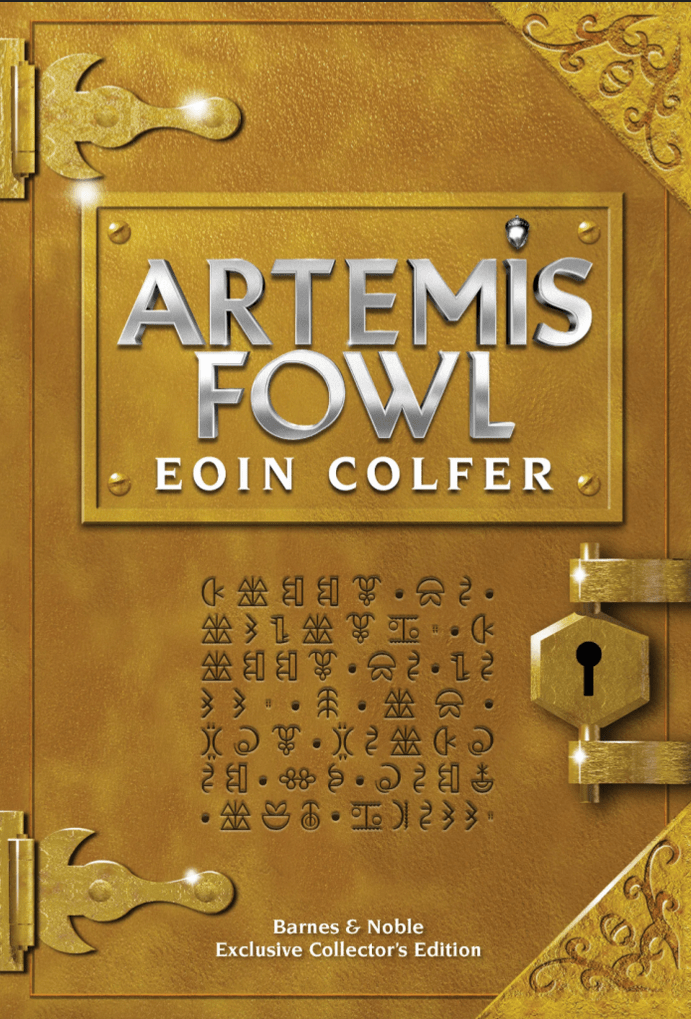
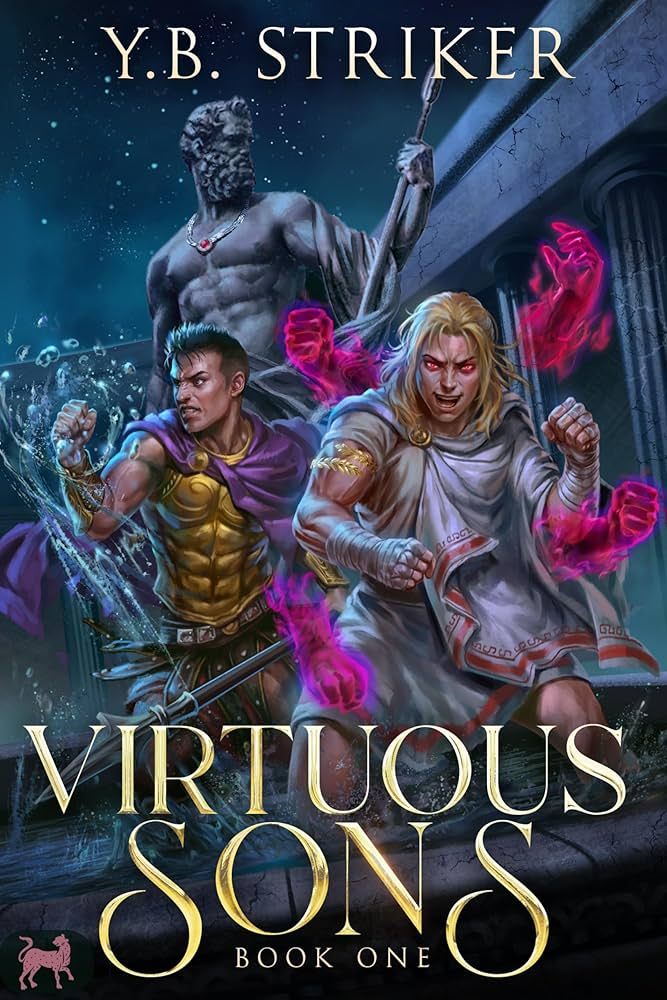
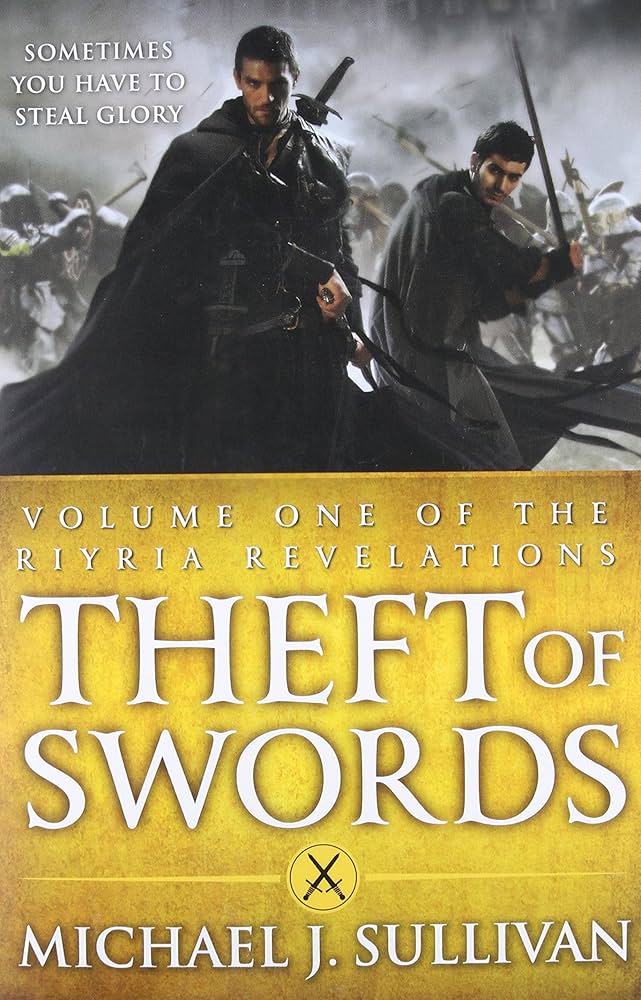
These are 8 of my favorite books of all time. Notice any commonalities?
All of these stories are about men (and boys) – clever, dangerous, heroic, stalwart men. Some are written for general audiences, while others go all in on the “bro vibes.”
Each tale contains passion and violence, loyalty and steadfast friendships, promises broken and kept, strategic and psychological contests, and a mix of wit and heartbreak. The ones that have stood the test of centuries reveal great truths about the human condition.
There’s something else I’ll point out though. The most recently published of these 8, Virtuous Sons (read my review) and Theft of Swords, were both self-published first, and only picked up by publishers after finding great success. The same is true of the wildly popular Cradle series by Will Wight and the Dungeon Crawler Carl series by Matt Dinniman.
2 more of my favorites, The Hands of the Emperor by Victoria Goddard (read my review) and Paranoid Mage by InadvisablyCompelled, have continued to gain momentum as self-published works.
It’s not like we have a net shortage of books about boys and men – that’s the majority of what’s been published for all of human history. But, naturally, modern readers gravitate toward books written in a modern voice – we want new ones.
If I, as a female reader, am irritated by the lack, I can’t imagine how frustrating it must be for male readers, especially boys and young men who are developing their taste for reading!
Big publishers don’t want boy books – they’re wrong
But the Big 5 publishers don’t want to publish “boy books” anymore. Many will deny there’s even such a thing as a “boy” book, or that there shouldn’t be (“that’s not inclusive!!!”).
I strongly disagree with all 3 statements:
I want to see boy books published – I want to read them! And edit them. And market them to more readers who will love them.
There’s definitely such a thing as a book by, for, and about men/boys, that male readers enjoy more than female readers (not that girls can’t as well – I’m a woman and you just saw my favorites list). That doesn’t change the fact that at the core, they are bro books.
There should be boy books. Stories that feel like they were written just for you are incredibly powerful! Everyone should have the chance to read stories that delight and resonate with the deepest parts of our soul. If that means reading books about people that are like you… well, duh.
Modern publishing has a chicken and egg problem. They claim they don’t publish as many books about male main characters because male readers don’t buy books as much as female readers.
Male readers respond thusly: “We’ve stopped buying your books because you won’t publish the types we actually want to read.”
There are thriving indie publishers and reading communities online for action and adventure books that are just straight up fun – no identity politics, no need for sensitivity readers – just cool dudes running around with swords. Virtuous Sons, published initially as a web novel on Royal Road, received over 4 million views.
In the past, before the digital age and the advent of self-publishing, books published by the Big 5 were the only option. If you weren’t reading them, you weren’t reading. In their elitism, the Big 5 have refused to adjust their attitude. They blame their potential buyers rather than their own business model. But men are reading. They’re just taking their time and money elsewhere.
And why wouldn’t they, when their tastes are being insulted?
No, I have no interest in reading any of the “adventure fantasy” books on Amazon with grotesquely proportioned anime pinup girls spilling across the covers. No more than I want to read any of the romantasy featuring glowering, glistening, shirtless shifters.
But male readers (and female ones) are told they’re stupid or backward for wanting to read books about male heroes running around killing dragons, clearing dungeons, leveling up with ridiculously powerful magic, sitting around with their comrades swapping scar stories, and chasing (and getting) the girl at the end.
You’re not stupid. Those are great stories. Some are just good stories – that’s ok too.
What I’m NOT saying
Because everyone gets triggered so easily these days, let me tell you what I’m not saying.
I’m NOT saying that girl books are stupid, or that female authors shouldn’t write the stories they want to tell, or that female characters are worse than male characters, or that if a book can’t appeal to a male audience too, it shouldn’t be published, or that female characters can’t compel male readers etc. etc. etc.
I’m certainly not saying that for a book to be truly great, it needs to be by, for, or about men.
But the publishing industry needs to stop saying the opposite. Stop telling (white) male authors that it’s their duty to step aside and “stop taking up the limelight already so that others can have their turn.” Stop telling authors that their stories are “too male-centric” and that unless they have at least one female POV/main character, their book won’t even be considered. Stop telling male authors that strong, masculine, confident male protagonists are inherently problematic.
Write boy books!
I want to read your boy books! Even more so, I want to read your “men books” – with characters worthy of the tag “epic.” So please write them (whether you’re a male or female author)!
If you’re also on the hunt for modern bro books, you’re not alone. Guess what my most popular blog post is? By a massive margin.
There is demand. Don’t let people tell you otherwise.
And if you’re a male author looking for a book editor, but are feeling a bit querulous after discovering that almost all book editors are women, you don’t have to worry that I’m going to treat you like a tasteless jerk for “having the audacity to think a story deserves to be told about a male main character who starts out as kind of a jerk.”
Characters are supposed to have weaknesses. There wouldn’t be a story if your characters didn’t have to grow and change.
Neither does a male protagonist have to be the most profound, unique character ever written in order to make a good story that readers will buy. The female protagonists in most modern books sure aren’t.
I would be delighted to read your story, review it, and perhaps even work with you to edit it into the best it can be.
So keep writing about brave boys and mighty men!
Hi, I’m Caylah Coffeen, a freelance editor and marketer of sci-fi and fantasy books. I love reading and writing and am a follower of Jesus Christ.
I’ve worked for Monster Ivy Publishing and Eschler Editing, and am currently a weekly editor with Havok Publishing. Reach out to chat about books and publishing!
Thanks for stopping by my website! I hope you’ve found some helpful resources about reading, writing, and publishing. If you liked this article, here’s some more free content…
So, your editor has sent you the manuscript assessment for your story, and it’s a good 10+ pages long. It’s packed with useful feedback, some tough suggestions, and market advice you may never have thought of. You’re probably feeling excited, thoughts whirling, but also a little intimidated about where to start. It’s a lot to consider all at once.
The last thing I’d want is to complete a manuscript assessment for an author, only for them to sit and stare at their draft, with no idea what to edit first. And that’s not the author’s fault!
Think about it. You were taught (or learned through experience) how to write and how to accept and incorporate feedback from other writers or beta readers. If no one teaches you how to break down a long editorial report into steps you can implement in page-to-page editing, it’s little wonder you might feel stuck or overwhelmed.
So here are 8 tips for self-editing your book using the developmental feedback found in a manuscript assessment:
Note: if you haven’t received a manuscript assessment, but are reading this article to determine how helpful it might be to acquire one, I recommend you check out this sample manuscript assessment I completed for one of my author clients.
1. Reorganize Feedback into a Simple Checklist
I tend to organize my manuscript assessments by topic:
Character arcs
Plot
Structure and pacing
Opening, mid-point, ending
Writing style
Marketability
More
However, this might not be the most helpful form of organization for you to refer to quickly while editing. You could rearrange feedback into a chronological checklist.
For instance, in my section on characters, I may offer the following feedback: “I immediately related to the characters, but drifted emotionally from them in the middle of the story when they lost sight of their goals, but was moved by how they pulled through in the ending.” I might also say of writing style: “The first half of your story contained a heavy amount of passive voice and some awkward sentence structure, but your writing improved over the course of the manuscript.”
You could then pull out feedback suggestions and organize them into an editing checklist:
Act 1 Edits: – Active voice – utilize a thesaurus to vary verb choice – Sentence structure – sign up for a free trial for a grammar program (like ProWritingAid) to highlight my most common problems with sentence structure – Reexamine my turning point moving from Act 1 into Act 2 – compare it to what I did in the opening hook – how can I strengthen it to propel readers into the middle of the story with greater character clarity?
If another method of organization is more intuitive to you, then go for it! The idea is to pull out the common threads and compile them into a quick reference sheet that you can work through methodically.
2. “Pants” it!
Or, you could just throw organization to the wind and start where you’re most excited! If you’ve already rewritten your opening more times than you want to count and you dread editing it AGAIN, then skip to the part you WANT to write.
Don’t worry about the whole manuscript. Pick one scene that you have a ton of new ideas for, and start playing with it. It doesn’t have to be the chapter that needs the most work, or the scene that’s most important to the story as a whole.
I hope you can still have fun! Even if editing isn’t your favorite part of the writing process. It’s so important to remember why we even do this. Cling onto the joy of your story!
3. Make small edits that affect larger patterns
Complete a read-through with an eye out for small choices that contribute to consistent problems or patterns. For example, if I tell an author that their protagonist often comes across as whiny and disrespectful, I will mention several specific scenes where this problem was most apparent to demonstrate what I mean. But I won’t list every single instance.
That’s what a developmental edit is for – in a full edit I would highlight each time the character’s attitude appeared problematic and offer suggestions for improvement. But after an assessment, it’s up to you to read through your work again, watching for others ways such problems may appear.
The same is true for any issue your editor mentions was consistent throughout your story – the dialogue was drawn out, the descriptions were confusing, the action scenes felt clunky, etc.
This is where an editing checklist can come in handy again. If there are problems you know will come up consistently, write yourself a reminder.
In each chapter, check: – MC attitude and speech – Can I trim dialogue? – Read descriptions out loud to see if I stumble over them. Rewrite and trim for clarity.
4. Brainstorm with Friends
Get a second or third opinion from writer buddies and beta readers, especially regarding feedback that is hard for you to hear. It’s difficult to maintain emotional distance from a story that’s so close to your heart. So how will you know which editorial suggestions you should definitely implement, and where you can trust your own instinct as a writer?
That’s where additional feedback can help! Talk it out with a friend. Share the editorial advice you received and ask them what they think. Even if you can’t find a critique partner for your entire project, you could find people who are willing to look at a few chapters.
When you start hearing the same thing from different readers of your genre (that distinction is vital), you’ll gain more confidence and clarity about the necessary changes.
5. Decide What Feedback to Reject
Decide what feedback you want to accept and what you don’t. You’re not going to agree with everything your editor says, and that’s ok. There may be things your editor doesn’t know about later books in your series, or you could just love the way you have something and not want to change it. Editing is a collaborative process.
Of course, don’t reject professional suggestions out of hand. Some changes won’t feel fun, but really will strengthen your story.
But you might come up with alternate ways to address a problem your editor raises. Suggestions are just that. They’re meant to be helpful, not to pigeon-hole you or kill your creative spirit and voice.
Trust your instinct! Don’t pain over everything. If there are gut decisions you can make after going through the assessment, write them down on a “do” and “don’t” list, and move on.
This is one way that editing with a manuscript assessment can be more efficient than working from a developmental edit! All of your feedback is in one place, so you can read through it and make your “yes”/”no” list quickly, without first having to re-read through individual comments on your entire manuscript.
6. Ask Your Editor Questions
If you’re stuck, feel free to reach out to your editor again! I always invite authors to send me follow-up questions, and surprisingly few do. Perhaps they’re being considerate of my time, which I appreciate. After all, if I ended up offering writing coaching, I should bill for that time. But I consider follow-up questions to be part of the manuscript assessment service. It’s not hard to answer a few questions over email.
I also really enjoy talking about the stories I’ve worked on! Sometimes I’m actually disappointed when the author doesn’t have anything to say after I return my work, because I’m invested in their story and so curious and excited to see how they develop it further! You love talking about your book – so do I!
Of course, you could ask for a one-off coaching session. Or, if you feel like you need more detailed edits on a “problem section,” you could hire your editor to work on certain chapters. Not all editors will agree to edit “a-la-carte” like this, but some do, especially if they’ve already read your entire manuscript and understand the context.
One of my clients, for whom I completed a manuscript assessment, later hired me to edit his action scenes, as that was an area of weakness I had highlighted. He decided it wasn’t worth it to struggle over them – it wasn’t one of his strengths. So we worked on those portions together. It’s a great way to stay within budget, while still ensuring your work meets the standards you want.
7. Allow Yourself to Take Breaks
You might think, “but I’ve already been on a break, waiting to get my assessment back. I should jump back in now.” Not necessarily. You can allow some time for the ideas to percolate.
It’s hard to open yourself up to feedback on your story, which is your precious baby! It’s ok to take a breather, go read or write something purely for fun, and then come back to the assessment once your creative juices are flowing again.
Often, I offer reading suggestions to authors in my assessments – whether standout works in your genre, comparative titles I think could help you pitch your book, or writing resources.
It’s better to do something productive or uplifting than stress yourself out or do nothing at all!
8. Make a Plan Against Procrastination
The longer you put off getting started, the harder it’ll feel to go back and look at that editing list again. Try to set a schedule, set aside a consistent time to write, and make some personal deadlines.
This often works best when you have a writing buddy who can help hold you accountable! Try swapping each newly edited chapter with a critique partner once a week or biweekly. Your speed of editing isn’t important, but chipping away at your project little by little IS – or it’ll never happen.
This is general writing advice. If you had the self-discipline to finish and edit a draft, and send it to an editor, then you’ve learned some great habits over the years! Apply what you know of yourself as you use your manuscript assessment, even if the process feels different from how you’ve worked in the past.
If you’ve edited your novel using the feedback from a manuscript assessment, what worked best for you? What didn’t? Reach out – we’d love to add your advice as an author into this post!
Hi, I’m Caylah Coffeen, a freelance editor and marketer of sci-fi and fantasy books. I love reading and writing and am a follower of Jesus Christ.
I’ve worked for Monster Ivy Publishing and Eschler Editing, and am currently a weekly editor with Havok Publishing. Reach out to chat about books and publishing!
Thanks for stopping by my website! I hope you’ve found some helpful resources about reading, writing, and publishing. If you liked this article, here’s some more free content…
“The Spirit of the Lord is on me, because he has anointed me to proclaim good news to the poor. He has sent me to proclaim freedom for the prisoners and recovery of sight for the blind, to set the oppressed free, to proclaim the year of the Lord’s favor.” Luke 4:18-20
Heavenly Father,
Bless me with confidence in the anointing You have given me to write.
You are the Author and Perfecter of our faith (see Hebrews 12:2), and I pray that You will help me as I author the words you have called me to share that will bring You honor and glory and breathe hope into the hearts of my readers.
Help me to not get distracted by worldly busyness and building my own platform, but to be busy building Your Kingdom and pursuing the calling You have given me, just as Jesus did (see Luke 2:49).
Protect me from the lies and deceit of the evil one. May I rest confidently in your truths and in my calling, rather than getting sidetracked by doubts, insecurities, and distractions. Equip me to write with courage, confidence, and faithful obedience.
Help me to focus on my readers, on their needs, on their struggles and desires. May every word, every message You want me to share flow into my writing.
Holy Spirit, You are welcome here. Strengthen and guide every word I write. Help align my motivations and desires with Yours.
Amen
*This is an edited excerpt from the anthology Prayers for Writers, to which Jenn contributed.
She also loves spending time with her husband and two sons, savoring coffee chats with friends, curling up with a good book, and enjoying a wonder walk through nature.
For additional resources to help you pray for your writing, check out her site Prayer Empowered Writer.
Hi, I’m Caylah Coffeen, a freelance editor and marketer of sci-fi and fantasy books. I love reading and writing and am a follower of Jesus Christ.
I’ve worked for Monster Ivy Publishing and Eschler Editing, and am currently a weekly editor with Havok Publishing. Reach out to chat about books and publishing!
Thanks for stopping by my website! I hope you’ve found some helpful resources about reading, writing, and publishing. If you liked this article, here’s some more free content…
Professional book editing can be pretty expensive. Perhaps you’ve researched standard rates, or have recently received a quote that’s outside your budget. Either way you’re probably feeling pretty frustrated and wondering if there’s a way to save on costs, without sacrificing on the quality of feedback.
I’m here to tell you there is! It’s called a manuscript assessment or manuscript evaluation – a detailed editorial letter summarizing developmental feedback (without in-line edits).
It’s hard to find an actual example of a manuscript assessment on the internet, but I’ve uploaded one (with my client’s permission) here! I’ll also go over:
A manuscript assessment is an 8-15 page editorial letter detailing developmental feedback on:
Characterization
Plot
Style
Pacing
Structure
Dialogue
Openings
Endings
Marketability
Recommendations for next edits
More!
Here is an example of a manuscript assessment which I completed on a speculative fiction novel, shared here with the author’s permission. The complete version I provided to the author was 15 pages, but I have redacted some content and blurred names to protect the author’s unpublished work.
Please note that my author-editor contract specifies that I cannot share any portion of an author’s manuscript or any sensitive details about their work (without permission), which is professional standard. This is why it is difficult to find examples of a manuscript assessment online, and perhaps why this service is not more commonly known by authors.
How a manuscript assessment differs from a developmental edit
A manuscript assessment does NOT include line-by-line edits and comments.
A developmental edit examines characterization, plot, structure and more through in-line comments and notations on the manuscript itself. An editor will include specific feedback throughout each chapter, sometimes even on every page (depending on how much work the writing needs).
As such, a developmental edit takes a lot more time, with much more detailed attention paid to each scene and portion of the manuscript.
A manuscript assessment summarizes the most significant feedback into a single document – saving the editor a lot of time!
How Much a Manuscript Assessment Costs (compared to an edit)
Because a manuscript assessment takes less time, editors can offer the service at much more affordable rates. Which is a huge win for authors!
A manuscript assessment usually costs half or less than half of a developmental edit, while still offering a significant amount of feedback.
The Editorial Freelancer’s Association compiles median editorial rates as self-reported by their members. Please note that since these are median rates, this means an equal number of editors charge above and below these amounts.
Median developmental editing rate for fiction: 3.0-4.0¢/word
Example project: a developmental edit on a 100,000 word fantasy manuscript would cost $3,000-4,000.
Median manuscript assessment rate: 1.5¢/word
Example project: a manuscript assessment for a 100,000 word fantasy manuscript would cost $1,500.
Our Book Editing Rates
If you are interested in working with Creative Cornerstones, my rates are $0.02/word for developmental editing and $0.007/word (a third the cost) for a manuscript assessment.
Example projects: a developmental edit on a 100,000 word fantasy manuscript would cost $2,000 and a manuscript assessment would cost $700.
Beware of excessively low editing rates
You may be thinking, “but it’d still be better to get a full developmental edit than a manuscript assessment. I could find someone online who will do a full edit for a lot less than $3-4K!”
That’s true. But beware of cutting costs too much, or you risk hiring someone whose feedback may actually do more harm than good.
I met a self-published author once who said she found someone on Fiverr to “professionally edit” her whole novel for only $200. That’s barely enough to cover, at a living hourly wage, the time it would take to read the full manuscript. This service may have functioned like a valuable beta read, but it was by no means a professional edit.
If you have to make the choice between hiring a hobbyist to complete a “full edit” and hiring a professional to complete a shorter task like a manuscript assessment, I would absolutely recommend the latter. You will gain more if a professional gives your book 20 hours of their time than if a novice gives your story 40 hours of their time.
Is a Manuscript Assessment the Right Choice for You?
Still, it’s not the right choice for everyone. Unless you are willing and able to put in significant work self-editing your novel, I would not recommend a manuscript evaluation.
A manuscript assessment is a great fit for:
Authors looking to traditionally publish their book who want to make their manuscript as competitive as possible before seeking representation.
Authors intending to self-publish their work who do not have the budget for a full developmental edit.
Authors who are confident self-editors, but are looking for a professional second opinion.
Newer writers who aren’t sure what their manuscript needs and are looking for detailed feedback that still affords room for significant rewriting.
I have worked with all of the above types of authors!
One of my author clients had been working on her story for over 10 years and had re-written it many times. She had reached a point of frustration – not ready to start on the sequel, and not confident enough to explore publication. She opted for a manuscript assessment almost as a way to receive writing coaching for her specific project.
Another of my clients is pursuing traditional publication, but he wanted to make his manuscript as strong as possible before querying agents since he understands how competitive the market is.
Why don’t more Authors know about manuscript assessments?
If manuscript assessments are so great, why is this the first you’re hearing of them?
Even after I started working in the publishing industry and was trained in the differences between developmental, line, and copy editing, I didn’t hear anyone talking about manuscript assessments.
I discovered the term quite by accident, and was astonished that it was not more widely known – because it is a perfect fit for authors looking to self-publish! Indie authors don’t have a huge budget, but still absolutely need to receive professional developmental feedback.
So many authors have reached out to me requesting a sample edit, gotten excited about moving forward, but then felt crushed when they heard my quote for a full edit. In such cases, I’m so glad to be able to suggest a manuscript assessment as an alternative!
I love books! I love authors! I want every writer to be able to afford professional feedback, even in a condensed form!
These authors go from crestfallen and overwhelmed, to delighted. So many have said, “I didn’t even know that was an option!” I feel frustrated on their behalf. The editorial industry has not done a good job of marketing this service.
How many self-published authors have inquired about professional editing, realized it exceeded their budget, and released their work without the benefit of any professional feedback?
I’m writing this article so you know there’s another option!
Yes, the best case scenario is to receive several rounds of editing on your work – developmental, line, copy editing, and proofreading. This is what traditional publishers do. Is this realistic for most indie authors? No. But it doesn’t have to be all or nothing. Getting a manuscript assessment and incorporating the feedback in a final round of self-editing can massively improve your story!
If you’re an author, I’d certainly love to work with you on your manuscript, but I’m writing this article mostly to educate the writing community. I hope you go on to tell all your writer friends that there is such a thing as a manuscript assessment!
If you are serious about your author career, then your books are a business. Every business invests upfront in creating a top-quality product. Your book needs professional developmental feedback to maximize its potential. But that doesn’t have to be out of reach for you!
Hi, I’m Caylah Coffeen, a freelance editor and marketer of sci-fi and fantasy books. I love reading and writing and am a follower of Jesus Christ.
I’ve worked for Monster Ivy Publishing and Eschler Editing, and am currently a weekly editor with Havok Publishing. Reach out to chat about books and publishing!
Thanks for stopping by my website! I hope you’ve found some helpful resources about reading, writing, and publishing. If you liked this article, here’s some more free content…
Are you an author who speaks English as a second language? Welcome! Whether you’re dreaming of publishing your book with a North American publisher, or looking to translate your novel into English to reach a wider audience, our team would love to support you.
First of all, I’d like to enforce the value of submitting your book to the English-speaking publishing market. According to data reports, books written in English make up between 1/3 to 1/2 of all global book sales.
In 2024, book sales in North America accounted for 33% of the global book market’s revenue. Europe accounted for a share of over 25% of worldwide book revenue.
Publishing your book in the English language will position your work in front of the largest demographic of book buyers in the world. A potentially lucrative choice!
Publishers and agents in these marketplaces are happy to accept the work of ESL authors from around the world, as long as your work holds up to industry standards. This means your work needs to be indistinguishable in quality from writing by native speakers.
Common English as a Second Language Errors
English is a hot mess! Native speakers admit it freely. The grammar is confusing, and it’s even harder to get the idioms right – for instance have you heard the phrase “hot mess” before? 😉
As an editor, I often see the same types of mistakes in writing by non-native English speakers:
Omission or incorrect use of articles such as a, an, the
Subject-verb agreement
Incorrect order of adjectives
Improperly used verb tenses
Overuse of passive voice and transitional phrases
Unclear sentence structure
Use of descriptors that don’t quite fit the context
A manuscript that contains basic errors like this will not appear marketable to an agent or publisher. Even if your English skills are exceptional, native speakers might still sense a stiffness to your style.
Working with a native English speaker will transform your novel, eliminating common errors and smoothing out cultural idiosyncrasies that you may not be aware of.
Editing Your Novel
I love working with global authors! You bring a unique perspective and style to storytelling which can be refreshing and exciting for native English-speakers to experience. As a reader, I am so incredibly blessed to have access to books from around the world that have been translated into my native language!
It’s been my privilege to work with authors from:
China
Central America
Ghana
Austria
Ethiopia
Types of projects I accept:
Manuscripts written in English by advanced or fluent ESL authors
Manuscripts that have been professionally translated into English and need a second look
Speculative fiction (sci-fi, fantasy, fairy tale and mythic retellings, etc.) is my specialty. I am also familiar with the mystery and thriller genres.
Projects I do not accept:
Manuscripts written by authors who are at the beginner or intermediate ESL level and still need significant language instruction
Manuscripts that have been translated with Google Translate, other AI, or a non-native English speaker
Nonfiction (excepting memoirs)
I would love to be able to work with all authors, but below a certain level of language proficiency, authors would benefit more from further language and writing instruction. A professional edit is a significant investment – it’s best to wait until your work is truly ready.
Self-Editing Support
I encourage you to take advantage of grammar and editing programs like ProWritingAid (both free and paid options available)! They highlight mistakes, but also explain each error, teach you the matching rule, and offer editorial suggestions. Unlike programs like Grammarly, ProWritingAid is designed for creative writing, not business or academic writing, and so they have better stylistic suggestions.
Running your work through programs like this can help you eliminate a lot of the more common mistakes, like absent articles, which will reduce the amount of time your editor needs to spend on later drafts – saving you money!
WARNING: Please be very careful not to write using AI! That is a sure way to get your work rejected by publishers. ProWritingAid offers suggestions for how to rewrite sentences. Do NOT just copy/paste them into your text. These programs are wonderful as a learning tool, but if you let them think for you, your writing skills will not improve.
How to Get Published in North America
Please note that while my team offers book publishing services to authors, including coaching, editing, self-publishing support, and marketing, Creative Cornerstones is not a publishing house or agency. We also do not offer translation services.
I would be delighted to edit your novel to maximize its quality and increase your likelihood of finding representation. I have worked with 2 publishing companies – Monster Ivy Publishing and Havok Publishing – and can advise you on the expectations of the publishing market in the United States.
Even native English speakers are increasingly hiring freelance editors before querying agents, because they know how competitive the industry is. In an attempt to cut costs, publishers are much more likely to accept a book that has already undergone developmental editing than one that needs significant rewrites.
Traditional publishing in the United States is dominated by the Big 5 Publishers:
Penguin Random House
HarperCollins
Macmillan Publishers
Hachette Book Group
Simon and Schuster
Each company operates many imprints – subsidiary publishing companies that they have acquired or created to specialize in certain sub-genres or audiences.
These companies are businesses looking to profit, so they seek books with mass appeal. They only offer deals for books they think will sell tens of thousands of copies – at least. If you’re seeking publication with a traditional publisher, you will first need to gain the representation of a literary agent.
For more information about finding a literary agent, I highly recommend Gina Kammer’s course on querying – she has over 15 years of experience in publishing and offers exceptional coaching to authors.
Other publishing options include mid-size and independent publishers, and self-publishing. I discuss these different routes in greater detail in the following article.
Ready to take your book to the next level?
I would love to hear more about your story and discuss how we could work together to make your book stand out in the crowd!
You are welcome to send me the first chapter of your book – I will complete a free sample edit on your first 1000 words and provide my recommendation for the type of edit your manuscript needs.
You can find a breakdown of the different types of editing – developmental, line, copy – here. Feel free to reach out to my team with any other questions as well!
Hi, I’m Caylah Coffeen, a freelance editor and marketer of sci-fi and fantasy books. I love reading and writing and am a follower of Jesus Christ.
I’ve worked for Monster Ivy Publishing and Eschler Editing, and am currently a weekly editor with Havok Publishing. Reach out to chat about books and publishing!
Thanks for stopping by my website! I hope you’ve found some helpful resources about reading, writing, and publishing. If you liked this article, here’s some more free content…
Kathy Tyers writes character-driven science fiction with a deep heart and an inquiring spirit. She is the author of the Firebird series – Firebird, Fusion Fire, Crown of Fire, Wind and Shadow, and Daystar – of the Star Wars universe novels Truce at Bakura and New Jedi Order: Balance Point, and of several stand-alones.
She returns to the Firebird universe with her upcoming release Firebreak, which takes place between Crown of Fire and Wind and Shadow. Releasing March 10, 2026 and now available for preorder, with 20% off on Enclave Publishing’s website!
Cover art by Kirk DouPonce at DogEared Designs
Lady Firebird Caldwell returns to the world of her birth, Netaia, intending to introduce her young sons to the noble Electors while her husband, Brennen, conducts a military inspection. When mysterious ships in distress suddenly approach the planet, the Electorate sends her to initiate first contact. Forced to work alongside a vengeful childhood enemy, Firebird uses everything within her power—even her passion for music—to negotiate, only to discover their alien technology threatens all the worlds she holds dear.
Facing ruthless betrayal, Firebird undertakes a deadly journey to salvage the mission. Brennen must make daring use of his telepathic powers to save human life in the galactic Whorl, including that of their young sons. But saving the worlds might force Brennen to give the order that would mean Firebird’s death. In a galaxy poised on the edge of ruin, survival may demand the ultimate sacrifice—from them both.
Caylah: I’m so excited to hear that you’re releasing a new book in the Firebird universe! The new cover looks stunning! Could you tell us more about Firebreak and how the story came to you?
One of the hardest choices an author can make is where to start and end their story – after all, the universe and characters never “end” in our own minds! It’s been quite a few years since your last book in the Firebird universe. How did you decide it was “right” to return?
Kathy: Caylah, thank you for the opportunity to talk about writing Firebird’s story again. If you don’t mind, I’d like to combine my answers to your first two questions.
In 2022, I thought I would never be able to write again. Long COVID had done bizarre things to my brain. Sometimes, I could barely wake up for two or three days, and then I’d have insomnia for most of a week. The worst of it was the sensation that something seemed to be creepy-crawling inside my skull. I barely had the energy to get through a day and cook dinner. Some people thought I was doing pretty well, but I had no energy left to write, which made me feel sad and old.
Still, every second Monday evening, I got together with some new writers from my church and helped them learn the craft. I tried to resurrect an old project of mine, Holy Ground, a rural fantasy novel. I’d written it in third person limited POV, and my writing friends encouraged me to try rewriting it in first person. Week after week, I simply had nothing to bring to the writers group. The passion just wasn’t there. I couldn’t persevere through the long, long process of writing a full first draft, even though the novel was substantially written already.
Finally, Broose–another founding member of that group, and a former Disney animator–challenged me to simply write something that brought me joy and fed my spirit. I had thoroughly enjoyed writing the Firebird series. They filled up something inside of me that had gone empty and dry during COVID. So, out of a sense of grateful nostalgia, I re-read all five of them. I found myself wondering what Firebird and Brennen were doing between Crown of Fire and Wind and Shadow. (Books 3 and 4) The next thing I knew, a new story was pouring out of me. The post-COVID lethargy was gone. Kathy Tyers was alive again.
Caylah: That is wonderful advice – returning to joy when our muse decides to hide under a rock. What did you enjoy most about this story and what are you excited for readers to experience (no spoilers of course!)? I’m personally excited to see more about Netaia’s culture and how it transforms over the years.
Kathy: The characters! I’ve known Lady Firebird for most of my life. Over the years, she has matured into someone who feels very real to me. So does Brennen. Letting them find each other and embark on their adventures together satisfied a hunger in my soul. In our fallen world, we long for a happy ending–but doesn’t a happy ending usually lead to the next challenge?
Caylah: Indeed! Firebird came so alive to me, so I’m excited to see more of her story.
How does your relationship with God influence your writing process and story planning? e.g. perhaps you have a prayer you like to pray as you sit down to write.
Kathy: I try to get to work immediately after my quiet time each morning. One of my favorite C.S. Lewis quotes says, in effect, that who/what you are will come out in your writing whether or not you try to put it there. So I work hard on telling a good story and, occasionally, on bringing forward the faith elements. Lightly but genuinely! The exception to “lightly” was Wind and Shadow, which was written as a Master’s degree project for Regent College, a wonderful theological school in Vancouver, BC. One of the main characters was a priest in training, you see….
Caylah: Amen! Out of the overflow of the heart, the mouth speaks. I remember you published a different edition of Firebird before your deal with Enclave. How did you choose to release a version with enhanced religious themes (is that the biggest difference)? Have you received criticism from fans of your general market (Star Wars) work?
Kathy: My editor Steve Laube had been a fan of my writing before I moved over from Bantam Books to Bethany House publishing, where he worked at the time. During our first conversation, he told me he had suspected for some time that I was a Christian because he’d found hints here and there in my writing (see C.S. Lewis quote above!). Yes, people have left reviews online warning other readers that my books from a Christian publisher have Christian themes. Surprise!
Caylah: Personally, I found the themes of shame, faith, and new life incredibly challenging and encouraging – they make the story have eternal significance. Are there any readers who’ve approached you over the years to share how the Christian message impacted them? All authors want to think that their stories have the power to transform at least one life!
Kathy: One of the most moving experiences in my life was attending the baptism of a young woman who said she’d decided to become a Christian after reading the Firebird books.
Caylah: I love how much you weave music into the chapter titles and into Firebird’s thought processes! In my opinion, that’s one of the elements that takes a character from “good” to “great” – their hobbies and passions actually transform how they view and interact with the world. I actually use your trilogy as an example when I offer this advance to new writers! Are there any other tips for character development that you’d share with budding writers?
Kathy: My characters usually reveal themselves to me slowly. I need to spend time with them, thinking through what they find beautiful, meaningful,or challenging. Often, it’s through the process of writing a first draft that I learn what drives them. I enjoy involving some of my characters in music or other arts because that’s been a big part of my background since childhood. I grew up in a musical family. I might ask a hopeful writer, “What do you enjoy, what do you know something about, besides your fiction? Can you layer that into your story in some way that enriches the plot?”
Now and then, though, inspiration hits in an instant. For example, I first glimpsed one of my favorite characters, Tel Tellai, when he was standing at the foot of a breakaway strip while a space-and-atmosphere fighter took off. He was just standing there in shock and protest, holding both of his arms stiffly down at his sides. “Who in the world is that?” I wondered. Calmly, he told me his name (honestly, that’s how it felt) and that he loved Phoena Angelo. I was shocked. “You love HER?? What???? How could ANYONE….”
Caylah: Moments of “conception” like that make storytelling feel like such a superpower! Since we’re quoting C.S. Lewis, your description reminds me of how his main character in Till We Have Faces says, “I was with book, as a woman is with child.”
The interrogation scene between Brennen and Firebird is one of the most tensely compelling scenes I’ve ever read – the chemistry! I remember the first time I read it, how Brennen’s act of clicking his heels together and shifting forward to begin accessing Firebird’s mind was such a tangible moment that made me physically feel the tension in the room. Then I reread your annotated version and realized you did this deliberately (as good authors do, haha)! You articulated so clearly how physical actions can punctuate energy and emotion and create turning points within a scene without the characters using any words. Are you able to expand upon that idea, maybe going into when this tactic works and when it might not, for some writers?
Kathy: Thanks, Caylah. I love that scene too. I wrote at length about tagging dialogue with action beats in my book for the Christian Writers Institute, Writing Deep Viewpoint: Invite your Readers Into the Story.It isn’t always easy to find the right action beat. I hear my characters speak to each other long before I can see their body language or their surroundings. Every writer’s process is just a bit different.
Caylah: That sounds like a great resource – thank you! It’s encouraging to know that even elements which might not come as naturally or quickly to writers can still become a great strength.
There’s a lot of disagreement about what makes a “strong female character.” Some people have complained that Firebird too quickly gets “shunted into the role of wife and mother,” but I think you did a wonderful job of showing a variety of feminine strengths in Firebird. Being a lethal fighter pilot isn’t the only way to kick butt, which she still does throughout the rest of the trilogy! How would you describe your approach to writing female characters and do you think Christians “should” write women differently than we see in mainstream media?
Kathy: I’m especially glad you asked about this. “The role of wife and mother” is not the end of any story. In and of itself, it’s a high calling for many. For others, it’s a vital step into their unique future. When I brought Firebird and Brennen together, I knew that they both had strong reasons for wanting to create a family.
Still, they obviously weren’t the kind of people to live quietly-ever-after. How, then, would they balance parenting with the other calls on their lives? It’s been a challenge for me, just as it’s been a challenge for them. But they’re doing it! Just wait till you read how they get there in Firebreak.
Caylah: I can’t wait to see the kind of trouble Kiel and Kinnor got into as kids!
Ok, now for my “fan girl” moment. When Brennen first feels Firebird’s mental shout he expects to find brotherhood. Though it didn’t turn out that way, I’ve been fascinated by what that dynamic would look like in their culture. I would LOVE to see a short story about a Sentinel “blood brother” pair!!! Do they have any famous “Gilgamesh-Enkidu” pairs or stories about sisterhood (which is rarer to find in fiction, sadly)?
Can individuals have more than one pair bond? For instance, would a pair bonded husband also be able to pair bond with a brother in arms? Would his bonded wife feel his brother through their connection at all? I then had fun imagining what would have happened if one of the Shuhr assassins had discovered they were connatural with one of the men in the Caldwell bloodline. What do you think would have happened – would they have stayed their hand as Brennen did with Firebird?
Kathy: You may have given me a great subplot idea. Thank you.
Caylah: Ooh, yes! Is there anything else you’d like to share about your story, process, or world?
Kathy: Thank you again for the chance to share a bit about Firebreak, my favorite characters, and my writing process. It was a treat to meet you at Realm Makers, and I hope to see you there again in 2026, when Firebreak is finally available!
Caylah: Thanks! It was lovely meeting you too. And congrats on the birth of your grandson!
Kathy: Thank you!
Follow Kathy Tyers on Facebook for more news and discussions, and find the first book in her Firebird trilogy here. Firebreak, releasing March 10, 2026, is now available for preorder on Amazon or through Enclave Publishing’s website (20% off there).
Amazon links are affiliate links – I may earn from qualifying purchases.
Hi, I’m Caylah Coffeen, a freelance editor and marketer of sci-fi and fantasy books. I love reading and writing and am a follower of Jesus Christ.
I’ve worked for Monster Ivy Publishing and Eschler Editing, and am currently a weekly editor with Havok Publishing. Reach out to chat about books and publishing!
Thanks for stopping by my website! I hope you’ve found some helpful resources about reading, writing, and publishing. If you liked this article, here’s some more free content…