
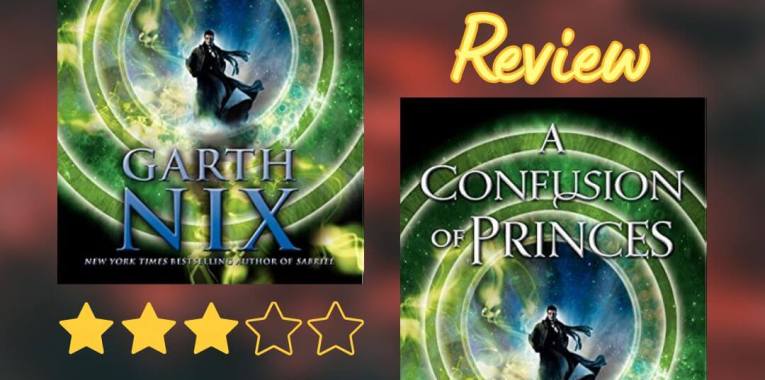
Rating: 3/5 Stars
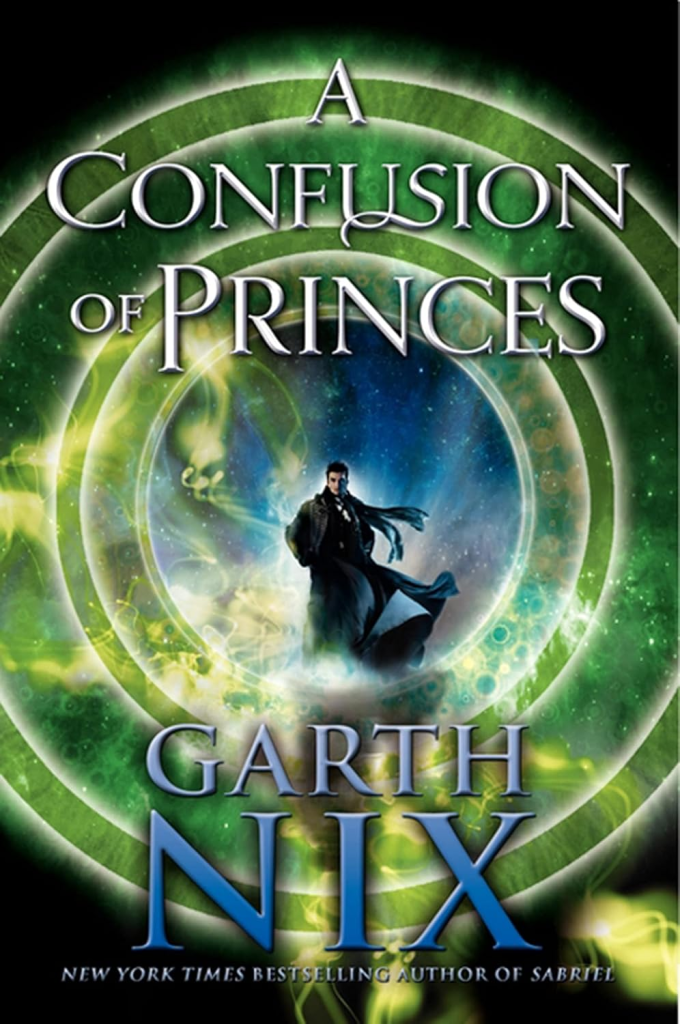
I loved Garth Nix’s Keys to the Kingdom series when I was a kid and was excited to pick up one of his other books (especially since I recently reread the Keys books and found my appreciation undiminished). His foray into space opera with A Confusion of Princes sounded fun, with some original worldbuilding concepts, but the story ended up trying to do too much and too little at once, resulting in a rather disappointing ending, particularly in the character development department.
Synopsis:
Khemri is one among millions of Imperial Princes (neutral gender title), taken from his family at a young age to receive biological and technological enhancements that will set him up for immortality and power. He expects a leisurely ascension, but on the day he comes of age, Khemri barely survives an attempted assassination and must flee the system with his only loyal servant. As he enters an Imperial naval academy, encounters the brutal politicking of other Princes, and learns secrets of the Empire that he never wished to know, he begins to question whether his “superior path” is really a life worth living.
Characters: 3/5
Khemri is a hilarious narrator. His older self tells the story in first person, looking back on the events. If it had been just first person, Khemri would have been a wildly unreliable narrator. His older self is aware of this, and shares both his original thoughts and his wiser reflections (“actually I was a spoiled idiot”), which makes for a highly amusing contrast.
He has a great mix of literal strengths (a whole heap of body augmentations and psychic abilities that are really cool to see in action), and latent character strengths – disinclination to bow and scrape to any authority, bravery, a thirst for fun and freedom (he really just wants to run around the universe with his own ship). Plus a host of weaknesses that at first he doesn’t think are weaknesses at all because of how he’s been raised – arrogance, disregard for any human life besides his own, entitlement, laziness, disrespect.
If we had been able to see Khemri really wrestle with these weaknesses, the outcome of the story would have been incredibly rewarding. But it’s more of an on-off switch. He lives for a time undercover with regular people, falls in love, and suddenly decides to jettison everything he grew up believing. That kind of sudden change is certainly possible in a person, especially in life or death situations (which it was), but we needed to see and feel it happen, rather than just be told of the shift.
The side characters are not developed very well, largely because Khemri doesn’t care about anyone but himself for most of the book. We don’t learn much about his super cool master of assassins, because Khemri just uses him or ignores him. This changes by the end, but the book is largely introspective rather than relational.
Plot: 3/5
This book seemed to jump all over the place. In some ways, I enjoyed how it kept surprising me – every time I thought I got a sense of where we were going, something shifted. It wasn’t a typical “super soldier academy” or “compete to become the next emperor” or “subvert the evil empire” story. But on the other hand, it tried to be a little bit of all of those at once, and therefore didn’t focus enough on any one of the arcs to make them compelling.
I think this book would have worked a lot better as at least a duology rather than a standalone – I actually didn’t realize it was a standalone when I started it. I just assumed it was a series, because the amount of worldbuilding we get right off the start indicates SO much could happen.
Instead, we get a little bite of everything, and then the main character moves on (usually not by choice) before we can really dig deeper into the relational dynamics at play. I personally would have loved to see a full book at the academy, a full book with him outside the empire, and a full book with him at its heart facing the political situation before all 3 elements came to a head.
As it is, we jump from conflict to conflict without any build up for the next – the finale didn’t feel like one because it started and ended so suddenly, with little time to catch up emotionally. The main character didn’t even really seem to care about what was happening, which made the readers care less too.
Worldbuilding: 4/5
I loved the worldbuilding here – it was my favorite part of the story, which is unusual for me. Usually I’m 110% about the characters. I suspect that Garth Nix cared about the worldbuilding more than the characters here too, which is why the ending fell a little flat. He wrote a worldbuilding piece that tried to have a character-driven ending, which meant neither worked as well as they could have.
But the psychic hierarchy of the empire is fascinating. Millions of Princes (both male and female but all called Princes) are taken from their families when very young, augmented and trained, and then join the “imperial mind,” a sort of hive controlled by the Emperor that connects them – allowing communication, witnessing, data transfer, orders, and the saving of consciousnesses for rebirth.
There are 3 types of dominant tech in the Empire that they all learn – psi-tech, bi-tech, and mech-tech – and some of the Empire’s enemies have superior ability with one but not all of them. We get one really cool battle with a parasitic alien race that has stronger psi-tech, nearly overwhelming Khemri’s mind. But then we move on…
We don’t really get to see him training with these (and I love training montages!), learning how to face the Empire’s enemies, or integrating into the larger political system of princes. Because the book covers 2 years and crams in a LOT – Khemri keeps moving around to new places so we get a bite-sized look at a lot of facets of the Empire and it’s abilities, but no real focus.
Writing: 3/5
This book was heavy on exposition. At first I enjoyed how Nix skips through time, skimming over unnecessary details to keep the pace moving. But there were some details I wanted to see, like Khemri’s military training, how he became friends with another cadet (we’re just informed “they became friends”), and how his love interest started to change his attitudes about what really matters in life.
That last one is the most important, because it’s falling in love with Raine that makes him completely change as a person, but we only get a few scenes of them in actual dialogue together. Then we’re informed they strike up a relationship and that things are mostly physical for a while, but then they do start “getting to know each other more.” We don’t actually see how and barely know anything about this girl. And so his transformation and choices at the end of the story felt unearned and emotionally uncompelling.
Audiobook: 5/5
I listened to this on audiobook and thought the narrator did an excellent job, particularly with Khemri’s self-deprecating sass!
Conclusion:
I’m glad I read this and it’s sparked a lot of worldbuilding ideas for me, but I really feel like Garth Nix could have done more with this world and these characters! I wonder if his publisher asked for a YA standalone (this was published back in 2012 at the height of the craze) when he might have preferred to write a more mature new adult trilogy. If he ever decides to publish a “revised author’s edition,” I would absolutely read it again.
This article contains affiliate links. I may earn a small commission on qualifying purchases at no extra cost to you.

Hi, I’m Caylah Coffeen, a freelance editor and marketer of sci-fi and fantasy books. I love reading and writing and am a follower of Jesus Christ.
I’ve worked for Monster Ivy Publishing and Eschler Editing, and am currently a weekly editor with Havok Publishing. Reach out to chat about books and publishing!
Thanks for stopping by my website! I hope you’ve found some helpful resources about reading, writing, and publishing. If you liked this article, here’s some more free content…
- Explore my list of YA science fantasy books featuring a male main character
- Send me an email to receive a free sample edit on the first 1000 words of your story
- Subscribe for future posts
