Guest Post by Dylan West
There are many benefits to selling books at in-person, local events, including finding repeat customers, gaining reviews, and selling more books in one day than you can sell in a whole month online! I’ve outlined some more benefits in a previous article: 8 Reasons Authors Should Sell Books at In-Person Events.
But here, I’ll share what I’ve learned from years of successfully selling books at markets, library fairs, and more. Knowing what to do, and just as importantly, what not to do, will ensure you actually make a profit. I’ll explain some vital tips like:
- How to select good events
- Simple tactics to sell books – inoffensively
- How to set up your table for maximum engagement
- What to bring
- Insider tips
How to Select good events
Ask other vendors or the even organizer what you can expect at their event. They won’t be offended and can give you an idea of the type of crowd to expect, and whether the event is worth your time.
High Traffic Events
The most important element to look for is high shopping traffic. If 10 people come to your event and you historically sell to 10% of the people you speak with, you might sell only 1 book at this event. If 500 people come to your event and you manage to speak to 100 of them, you might sell 10 books.
It’s most likely that the traffic will be high if you:
- Table up on a Saturday.
Saturdays are the very best day for sales events, hands down. Friday evenings are the next best. Sundays are a gamble. Sometimes a Sunday can give you decent traffic and other times the event is a complete ghost town. - Pick an event in a big/medium size city
that is close to major highways and civilization. If you table up on a farm in the middle of nowhere in a town having a name you’ve never heard of and has a population of < 5,000, you probably shouldn’t expect much traffic, and you probably shouldn’t table up there, unless you know from experience that this event really does draw crowds. And don’t assume that just because a podunk venue draws a moderate crowd on a Saturday, you can expect a decent crowd on Sunday. Sometimes the switch to Sunday kills shopping traffic. - Sell at established markets
with known traffic instead of inviting friends to your own private book signing event. If you invite 20 people to a signing and only 5% actually show up (which is about the average), you might get 1 person to show up! Many authors end up with NO attendees and get discouraged. Unless you’re a big name author, or you invited over a hundred people, don’t do this! Sell at markets that you know get at least 500 shoppers. - Choose a market that happens every week.
These are the safest events, because the event organizers typically do much more advertising of the event and the crowds are usually bigger. I make one local farmers market the backbone of my in-person sales—I go every Saturday from 9a to 2p. I do other events on Friday nights/Saturday nights/Sunday afternoons when I find them in addition to my regular Saturday morning market.
Low or no vendor fee
Let’s assume each book you sell nets you $5 of profit and your table fee was $100 for your event. If you sold only 10 books, that nets you $50. After you pay your fee, you just lost $50 to be at that event. On the other hand, if your fee was only $20, you earned $30. If you did a free public library event, you earned all $50.
Organizer doesn’t require vendor insurance
I’ve heard of events that require this, and in many cases that insurance can cost thousands of dollars each year! Avoid those events. Pick ones that only ask you to sign a form saying you accept risk for your own wares.
Close to home
If you have to drive a few hours to the event and a few hours home, you will burn away all your profits in gas expenses. And if you travel far enough, you’ll want to stay at a motel if it’s a multi-day event. If you pay $50 in gas and $100 in hotel fees, plus a $50 table fee for 2 days, that’s a total expense of $200.
How many books would you have to sell just to break even? Assuming from before that you net $5 profit on each book sale, that means you have to sell 40 books that weekend. If you think you can sell at least 20 books each day, you might cover your table fee. If you can’t, then you will lose money.
Simple tactics to sell books – inoffensively
Call out to passersby
If you only smile and wave, the vast majority of people will breeze right past your table. You’d think these people would proactively approach your table because they came to the event to shop, but they have to be drawn over to you.
Often they have dozens of tables to choose from. Even people who love the genre you sell will fail to recognize your books with their very obvious genre-hinted cover art and your large-lettered signage.
What should you call out? I use a variety of lines:
- “Free chocolate! Calorie-free books!” while pointing to my candy dish and books
- “Science fiction and fantasy!”
- “Buy a book and get a free spouse! Erm… I mean a free bookmark!”
- “I’ve got chocolate, I’ve got books, I’ve got chocolate books!”
- “Free chocolate and dad jokes!”
- “You have a sci-fi reader in your family?”
Be funny and relaxed. Many will stop and chat because you got their attention. If you keep it silly and lighthearted, people are less likely to be annoyed that you’re hawking them.
Put your book in their hands
If someone stops and asks what your book is about, don’t answer verbally. Instead, put your paperback in their hands with the back cover facing up and say that the book description says it best. This does several important things:
- The book has now become real to them. They can feel the texture and weight of it.
- By reading your back blurb, they’re getting a sampling of your writing style. If you’ve written it well, you can impress them with your writing skill and intrigue them about the book.
- If the blurb gets their attention, they will often start flipping through the book. And if your formatting is top-notch, they will see how professional the product is and their confidence in you goes way up. If you have interesting chapter titles, they may notice those and be drawn in further. They might even start reading the first page!
Every second they spend examining your book invests them further in it. Now they’re spending time. Once they’ve done that, they are more likely to spend money on it. This has now become an event.
While people are reading your blurb, you get to watch their face and see their visceral reaction to it. If their brows rise and their faces glow, your blurb is doing its job. If you never get such a response from dozens of visitors to your table, you know it’s time to rework your blurb.
While people are reading your blurb, you’re also freed up to call out to other people.
If you explain your book’s plot to each person who asks, your voice will get tired quickly. Especially if you have to shout over loud street musicians.
How to Set Up Your Table for Maximum Engagement
Location is Paramount
It doesn’t take much at all to discourage shoppers from approaching your table. They will never tell you the reason. It’s up to us as vendors to figure out what that obstacle is, and remove it.
If removal is possible. You might have to ask the event organizer if you can shift your table over a few feet to avoid something like a tree stump or a narrow part of a hallway, or to move you to a completely different spot along a street.
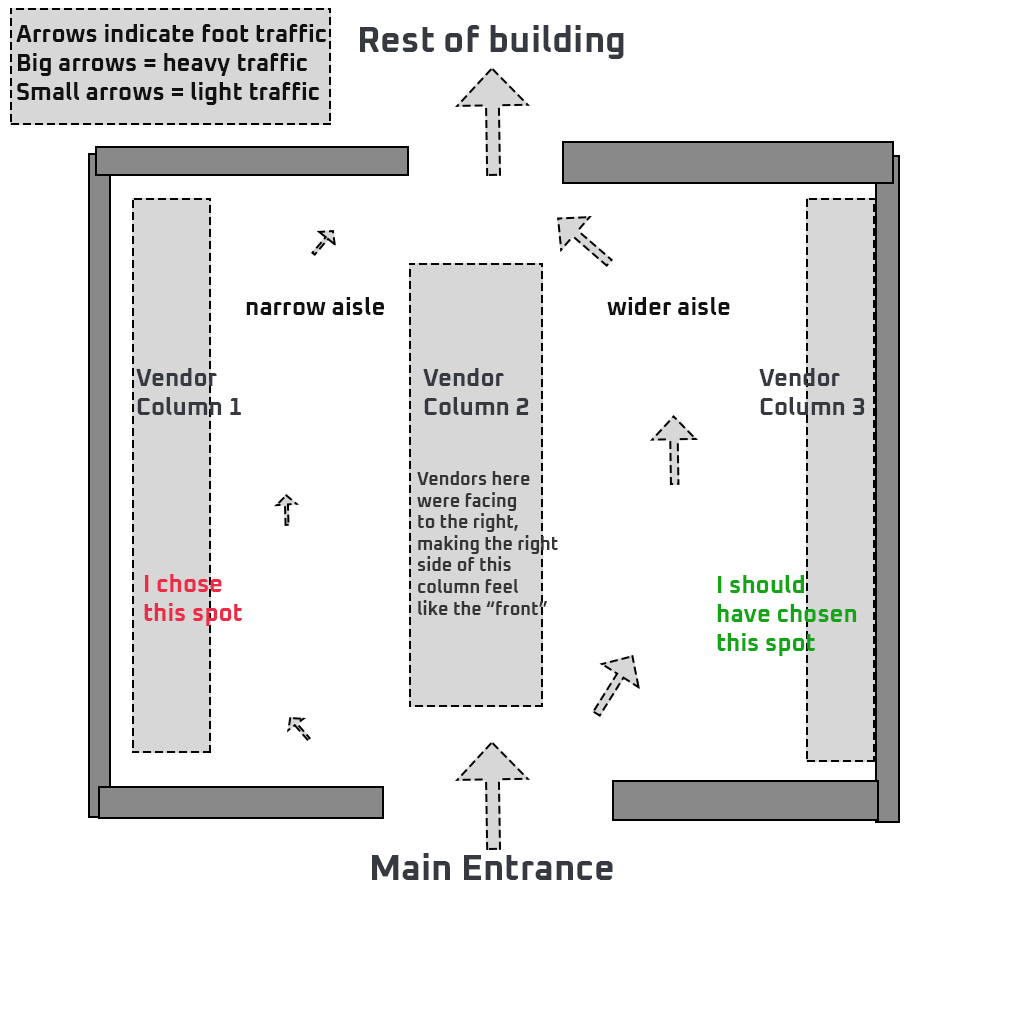
If you get to choose your table location, think carefully about possible traffic flow. For example, if your vendor area is divided into 3 columns of tables with 2 aisles, pick a spot on the right-hand column. Especially if that aisle is wider than the other! I learned this lesson the hard way at one of my library events:
Remove psychological barriers
Here’s a list of some I’ve discovered:
Distance
Move your table as close to the flow of foot traffic as you can. If visitors are walking in the middle of a street and your popup canopy is 7 feet away, most people will let their momentum drag them right past. And if your table is near the back of your canopy, such that visitors have to enter the canopy and walk a few feet inside to see your book covers, that’s too far.
It presents a subtle psych barrier that discourages all but the most determined visitors. And if you only talk to the most determined visitors, you will not sell many books at your event. I promise you.
Objects
At one event, I moved my table to the front of my canopy, but due to space constraints, one corner of my table butted up against a canopy pole. And my books were sitting on that end of the table. Could visitors easily avoid the pole? Sure. Did visitors let that pole deter them from approaching? Absolutely. Once I moved my books to the other end of the table, more visitors stopped to check them out.
Flooring
At an outdoor event, the ground was muddy from recent rain and I didn’t want someone dropping my books in the mud. So I laid down puzzle piece rubber waffle boards in a 9ft square and set my table on that. It jutted out a good 4 feet from the front of my table and I remembered thinking people might hesitate to approach for fear of tracking their muddy shoes on my clean waffle boards.
Guess what? The very first couple stood a few feet back from those boards and squinted. I immediately removed that layer of flooring and people started coming up to the table.
Turnaround Point
This is the worst obstacle of all. At one event, my table was near the end of a long street. There was nothing exciting at the very end of the street to draw people to walk the whole length. And so, for the first hour, most shoppers would walk to what I called “the turnaround point”.
About 2 tables away from mine, there was this spot on the road where I saw hundreds of people stop, squint down the road, decide they were at the end, turned around, and walked back the way they came. This was the most discouraging experience I’d ever had as a vendor.
At least until the shaved ice truck came and parked at the very end of the road! And then a street musician started strumming a guitar across from that. Then I had shoppers lining up in front of my table for shaved ice on a very cold day. And only then did I sell books.
Smart event organizers are aware of the turnaround effect and will place attractions at the end of hallways and streets to mitigate it.
Wide lanes
Similar to the point about distance, you want to try to avoid placing your table in a section of a path or street that is wider than the other sections. Shoppers will naturally tend to walk at the farthest point in the path from vendor tables, so if you pick a very wide section, shoppers may be too far away to see or hear you, and may feel the distance to be socially acceptable to ignore you from.
If you are able to relocate your table or move other structures (such as a friend’s tent or table) into the path across from you to narrow it down, you may turn a zero sale night into a big night.
What to Bring
Interactive Materials to Make Your Table Memorable
I bring the video game version of my debut novel for visitors to play:

This big monitor and the gaggle of kids and their laughter draw lots of people over (not to mention the parents). But you might not be able to create your own video game.
There are other gimmicks you can try: set up a gumball machine that dispenses slips of paper containing neat one-liners from your books, and make one of them a coupon for a free book. Or dress up in a costume related to your protag or villain. Just make it visually obvious that something about your table is different.
People should be able to say, “his table is the one with the [blank]!”
Ample Lighting
For outdoor, evening events during fall and winter, bring plenty of lighting, including hand lamps that visitors can hold up to your book. Don’t count on general area lighting and lights you string along the top of your canopy to provide enough light for reading your book’s back cover. At some events, they’ll ask you not to bring a popup canopy because it would block the lighting they provide and take up too much floor/ground space.
two tables
Always bring a small table along with your normal, big one. Sometimes events will let you in without prior notice or give you really juicy spots if you let them know you can fit your stuff on a 4ft by 2ft table and don’t need to use your 10ft by 10ft canopy. Some events promise to provide a table and chair for you. I always bring my own just in case they run out or there’s something about their table and chair I really don’t like.
a card reader
I recommend Square. The small reader is free with your account and the thing is durable—it can survive a trip through the washing machine! And don’t sign up for your account right away. Instead, ask another author who already has Square (like me!) to send you a referral email.
Only sign up with that referral and both you and the referring person enjoys a free $1000 of processing fees waived for 6 months, starting from your first card swipe. Just find a dedicated place to keep your square reader (not your pocket) so you don’t lose it and you don’t send it through the wash. Also, you must keep your smartphone charged in order to use the swiper (if you get the free swiper model, that is).
Make sure to ask about WiFi availability ahead of time!
Insider Tips
Chat with other author vendors
Ask them what other events they’re going to next. Be friendly to them—they just might end up inviting you to awesome events you didn’t know anything about. And they might offer to split their table with you. That lets you pay half the fee and gets you into events for which the submission deadline is long past.
I’ve gone to events that I heard about the day before! In order to capitalize on these last-minute event invites, try to keep your weekends open (if you don’t already have events scheduled, that is).
Sell at the last minute
When breaking down your setup, put your books away last. I can’t remember how many times I’ve sold books to passersby while I was packing away other things. One time I sold books after I’d broken down my entire setup because my backpack has a full sales kit in it, and I pulled books and a card swiper out from that.
At my farmer’s market on 10/12/2024, I sold 10 books after I started breaking down my table! All I did was look up for passersby, point to my books, and say, “I still have books out, if you’d like a look.”
Here’s what I’ve noticed: Many shoppers walking around after the official end of an event are happy when a vendor notices them and gives them something to shop for after all other vendors are closed. The last-minute nature can help nudge them to buy something. This is why I pack away my books last. I even bring down my tent and pack that away before I box up the books. I recommend you do the same.
The First Day of Events is the Most Important
If you sell at an event that lasts 2 or more days (of equal duration), and you can only show up on one of those days, pick day one.
Push for early sales on day one of multi-day events. Many shoppers may not feel any urgency to shop until later in that weekend. Always try to encourage them to buy sooner, because they may not return to you later like they promised!
As the event wears on, you’ll start hearing shoppers say things like, “I’ve already spent all my money.” And what they really mean is, “I’ve already spent all my money on other vendors’ goods. You’re too late.” The younger the shopper, the truer this is.
My sales and marketing guide has WAY more content like this. Just email me at dylan.west@dylanwestauthor.com if you want me to share that google document with you for free!
Thanks and Book Appetit 🙂
About Dylan West

Dylan West writes faith-based, young adult science fiction and fantasy novels. He is a Jesus lover, web and video game developer, former Navy nuclear operator, foreign language nut, and a nut in general.
While other people are busy thinking normal thoughts, he’s crafting corny jokes. Dylan lives in Chesapeake, VA, with his wife and daughter.
You can play the related game that pairs with his first book, Scribes’ Descent, here: https://dylanwestauthor.com/demo.